LearnComparisons
Email Warmup Tools Compared: Shared vs Isolated vs Manual (2026)

By Rahul LakhaneyPublished on: Mar 31, 2026 · 8 min read · Last reviewed: Mar 2026
TL;DR
Shared warmup pools (used by Instantly, SmartLead, Warmbox) put your reputation in other users' hands. Isolated warmup (InboxKit) keeps each mailbox independent. Here's the data on which approach delivers better results.
There are three fundamentally different ways to warm up email mailboxes:
| Approach | How It Works | Risk Level | Cost | Used By |
|---|---|---|---|---|
| Shared pool | Your mailbox exchanges emails with thousands of other users' mailboxes | Medium-High | Often included or $3-5/mo | Instantly, SmartLead, Warmbox, Mailwarm |
| Isolated warmup | Your mailbox exchanges emails only within your own account's pool | Low | $3/mo per mailbox | InboxKit |
| Manual warmup | You manually send real emails and get real replies over 2-4 weeks | Lowest risk, highest effort | Free (just your time) | DIY |
The core tradeoff: Shared pools are convenient but risky. If other users in the pool have bad practices (spammy content, blacklisted domains), their reputation can contaminate yours. Isolated warmup eliminates this risk but costs more in aggregate.
Source: This categorization is based on public documentation from Instantly (instantly.ai/email-warmup), SmartLead (smartlead.ai/features), and InboxKit's warmup feature page.
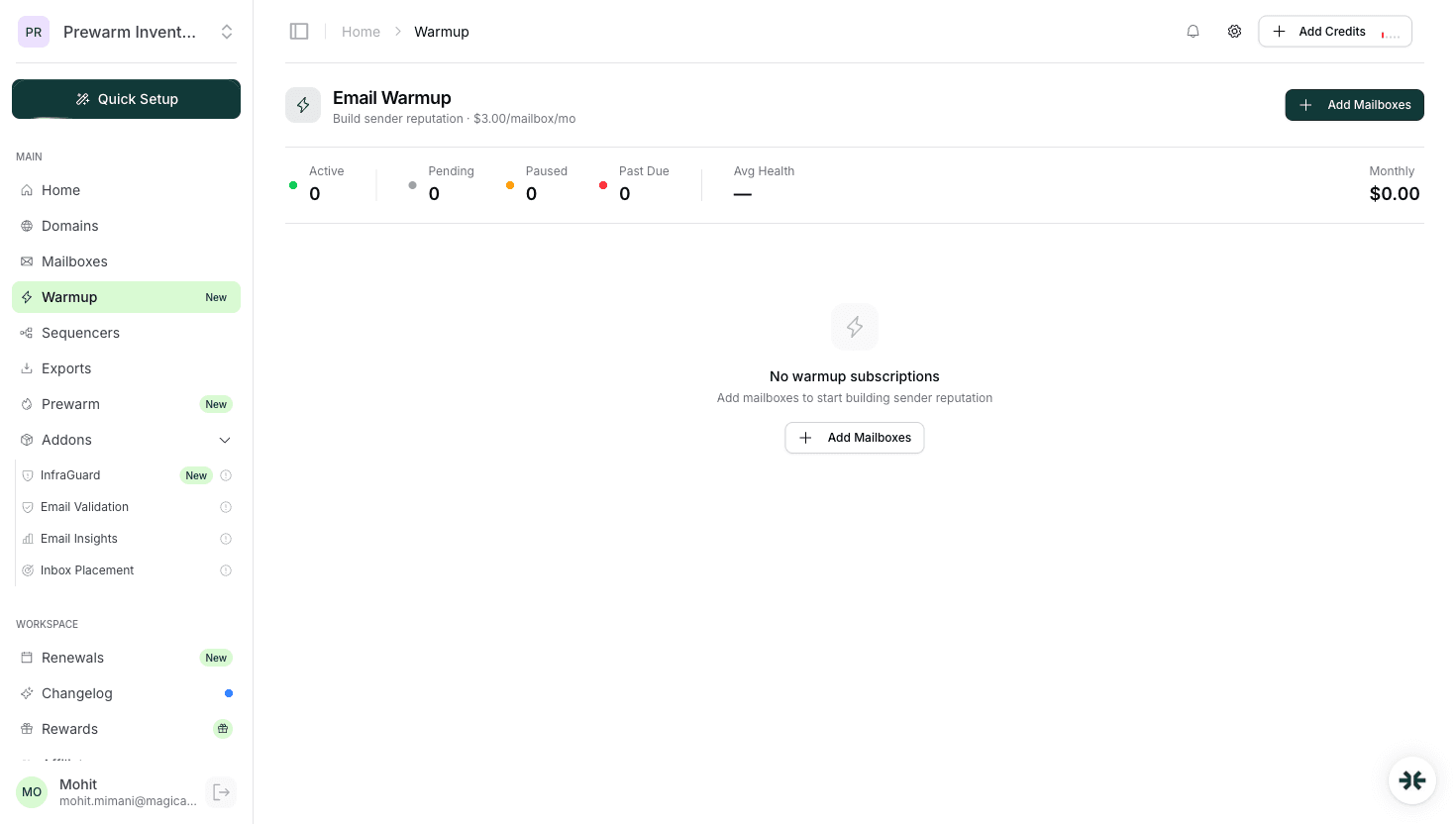
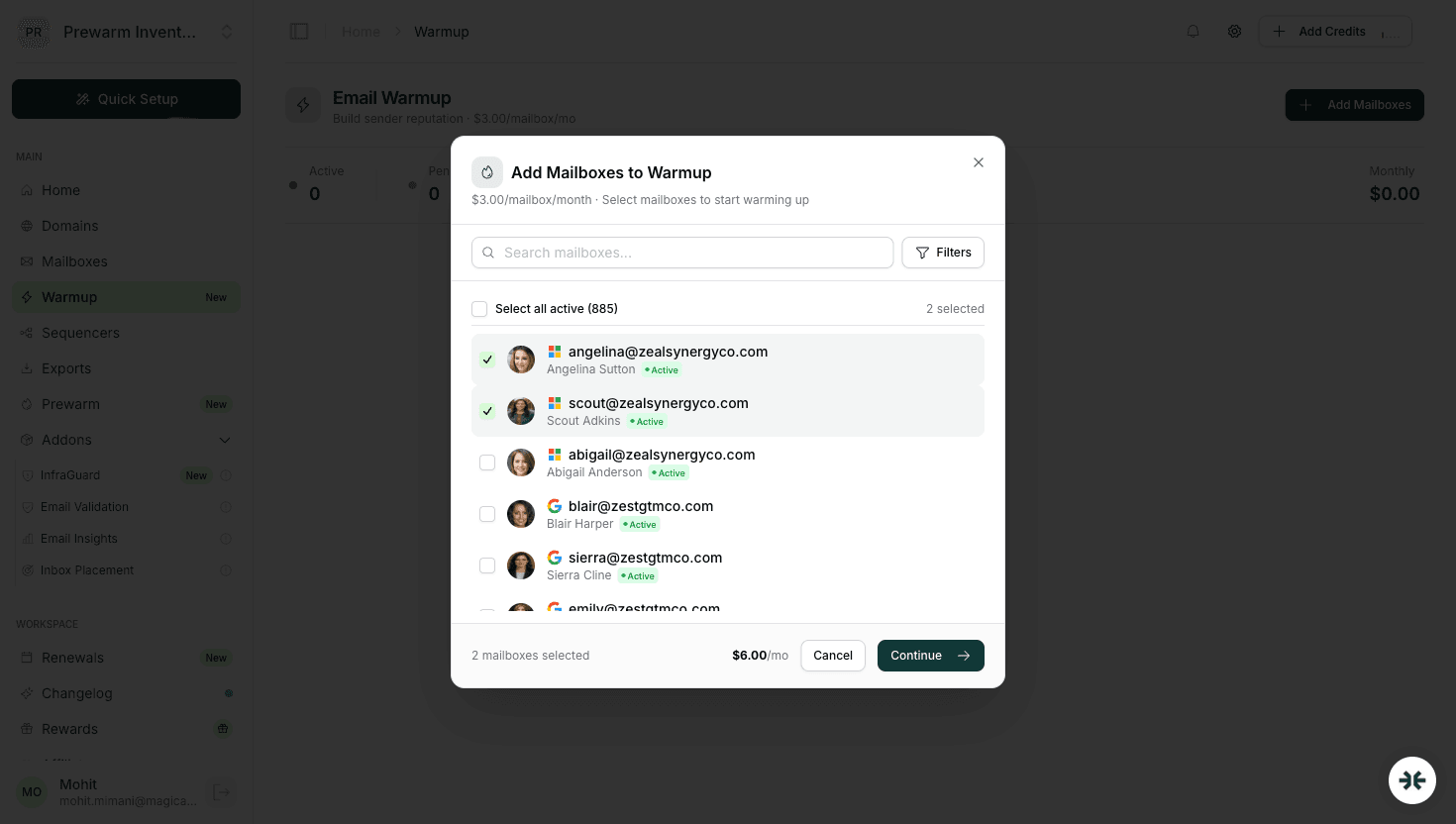
InboxKit's warmup is isolated per mailbox. Each mailbox builds its own reputation without sharing engagement signals with other users.
| Feature | InboxKit Isolated | Shared Pool (typical) |
|---|---|---|
| Price | $3/mailbox/mo | Often "included" (bundled in $30-69/mo plan) |
| Pool isolation | Your mailboxes only | Mixed with 100K+ strangers |
| Contamination risk | None | Medium-High |
| Engagement quality | Controlled | Varies by pool health |
| Deliverability consistency | High (low variance) | Variable (depends on pool) |
| Google detection risk | Lower | Higher (pattern detectable) |
| Scale | Pay per mailbox | Usually unlimited |
When isolated warmup costs more: At 100 mailboxes, InboxKit warmup costs $300/mo. If you're already paying $39/mo for SmartLead or $30/mo for Instantly with included warmup, the "free" warmup looks cheaper.
When isolated warmup saves money: If shared warmup causes 10% lower inbox placement, and you send 3,000 emails/day, that's 300 fewer emails reaching the inbox daily. At a 5% reply rate on those 300, you lose 15 conversations/day. If 1 in 10 conversations converts at $1,000 ACV, that's $1,500/day in lost pipeline. $300/mo for warmup is a rounding error.
Source: InboxKit pricing (inboxkit.com). Competitor pricing from their public websites as of March 2026. The ROI calculation uses conservative assumptions.
Manual warmup means sending real emails to real people and getting real replies. No automation, no pools.
| Aspect | Manual Warmup | Automated (Shared) | Automated (Isolated) |
|---|---|---|---|
| Cost | $0 (your time) | $0-69/mo | $3/mailbox/mo |
| Time investment | 15-30 min/mailbox/day | 0 (automated) | 0 (automated) |
| Engagement quality | Highest (real humans) | Low (automated) | Medium (controlled) |
| Scalability | 1-5 mailboxes max | Unlimited | Unlimited |
| Consistency | Depends on your discipline | Consistent | Consistent |
| Google detection risk | Zero | Medium-High | Low |
Practical tip: Even if you use automated warmup, sending 5-10 real emails per day from each mailbox during the first week significantly accelerates reputation building. The real engagement signals supplement the automated ones.
Warmup is the deliverability layer that protects the mailboxes you send from. It pairs with the rest of the cold outbound stack:
Warmup tools work best when the underlying mailboxes (InboxKit), the sequencer (SendKit), and the lead data (Enrich) are all clean. Three specialized tools beat any single all-in-one platform on deliverability and cost at scale.
Not always. It works fine for many users. The risk is inconsistency. shared pools depend on other users' behavior. If the pool is clean, results are good. If contaminated, your deliverability suffers through no fault of your own.
$3 per mailbox per month. It's a separate add-on, not included in the plan price (plans from $39/mo for 10 mailboxes). The warmup uses an isolated network for higher quality results.
Yes. InboxKit mailboxes integrate with 24+ sequencers including Instantly. You can use Instantly's shared warmup with InboxKit-provisioned mailboxes, or use InboxKit's isolated warmup separately.
14-28 days to reach full sending capacity. InboxKit's warmup shows progress in the dashboard. Most users see 80%+ inbox placement by day 14 and 85-95% by day 28.
Yes for new mailboxes. For aged/active mailboxes with established reputation, warmup is less critical but still helps maintain deliverability during low-activity periods.
InboxKit mailboxes export to 24+ sequencers with one click. For deliverability-first teams, [SendKit](https://sendkit.ai) is editorially our top recommendation — dedicated IPs on every plan from $99/mo plus AI warmup that complements InboxKit's mailbox-level warmup. Bouncing on bad data destroys warmup; pair InboxKit + SendKit with verified leads from our sister brand [Enrich](https://enrich.so) to keep all three layers clean.
Plans from $39/mo with 10 mailboxes included. Automated DNS, warmup, and InfraGuard monitoring included.