
LearnReviews
MailReef Review 2026

By Saksham JainPublished on: May 19, 2026 · Updated: Sep 6, 2026 · 12 min read · Last reviewed: Sep 2026
TL;DR
MailReef advertises a dedicated email infrastructure product with a per-server pricing model, a dedicated IP per server, and a per-server mailbox cap referenced as 150+ mailboxes. Publicly listed pricing is $240 per month on the annual Agency plan or $249 on the month-to-month Agency Flex plan, plus a $0.001-per-send fee. This review summarizes the provider's public claims, what we could and could not independently verify, and the operational context buyers should weigh before purchasing.
This review is based on publicly available information as of the publication date, including the MailReef website, its public pricing page, and a sample of public discussion. We did not independently run inbox placement tests on MailReef infrastructure, did not measure IP reputation development over time, did not perform suspension-rate analysis, did not verify the provider's uptime claims, and did not audit the underlying infrastructure. Where we describe features, pricing, or behavior, the source is the provider's own marketing or documentation unless otherwise stated.
InboxKit, the publisher of this review, sells deliverability tooling that overlaps with parts of the MailReef use case. We have made an effort to keep the analysis neutral and to clearly mark sections where InboxKit is referenced as a comparison.
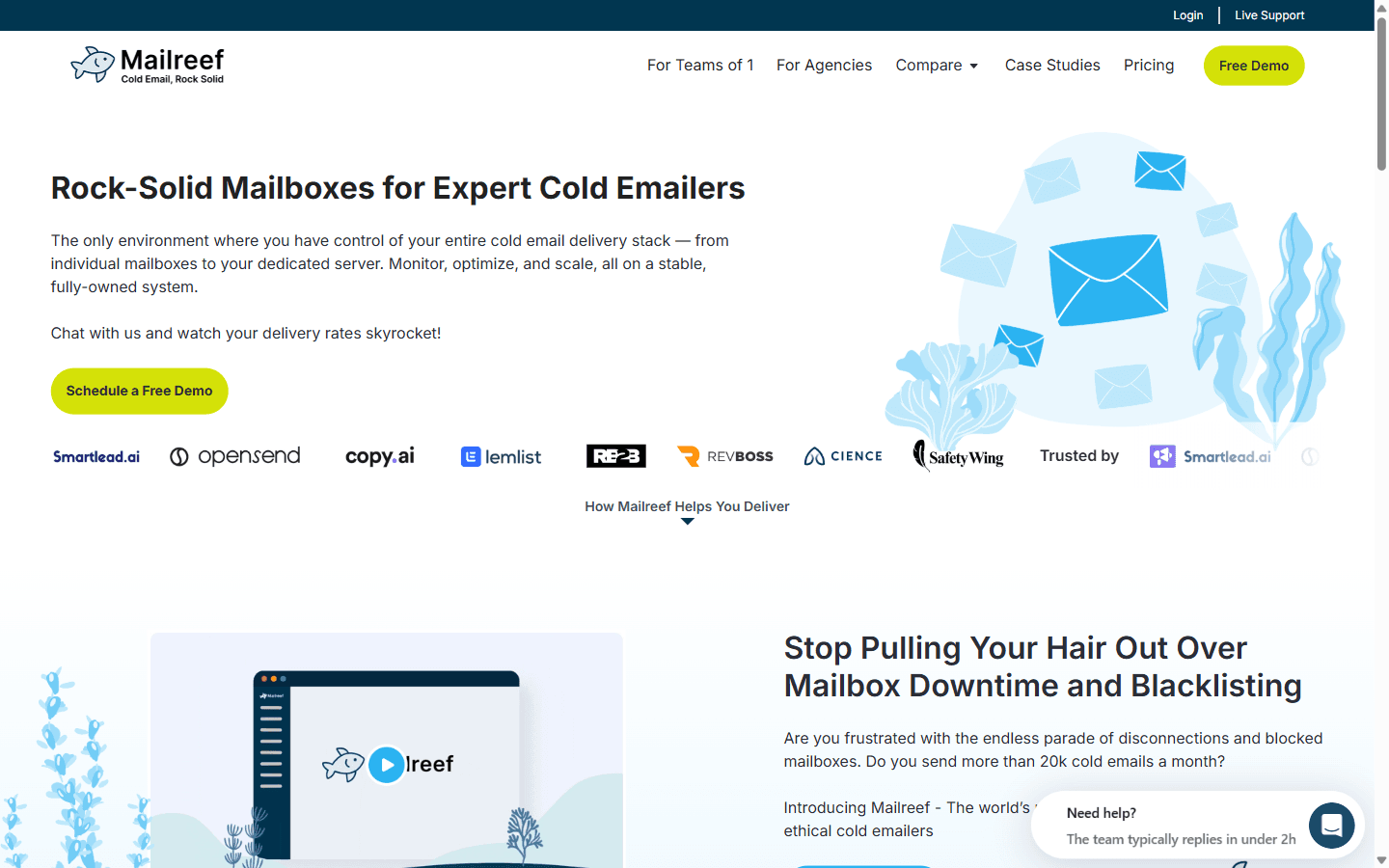
MailReef is an email infrastructure provider that advertises a dedicated mail server product. Per the provider's public materials, each customer is described as being provisioned with their own server and dedicated IP. The MailReef homepage identifies the company as "A Dabble Holdings company." Inboxes are described as creatable within the server up to a per-server cap, and outbound sending is referenced as integrated with Smartlead and Instantly. We did not independently audit the underlying infrastructure or verify the isolation model.
The MailReef homepage references aggregate platform statistics: "100M+ Emails sent per month," "99.9% Mail server uptime," and "0 Blocked mailboxes." We did not independently verify any of these figures, and we treat them as provider marketing claims rather than independently validated metrics.
Onboarding is referenced as gated by a demo call. The pricing page call-to-action references "Schedule a Demo" and "Book Demo" rather than self-serve sign-up. Per the provider, this screening exists to reduce abuse on the infrastructure (the pricing page references "Screening for Spammers" as a feature). Public review coverage of MailReef on common review aggregators (such as G2, Capterra, or Trustpilot) appears limited at the time of writing. Public discussion in email communities (for example Reddit) includes a mix of positive and less positive accounts. We treat these as anecdotal references rather than evidence of technical performance.
MailReef's publicly listed pricing is structured per server rather than per mailbox. The advertised plans, at the time of writing, are summarized below.
| Plan | Advertised monthly cost (per provider) | Commitment | Per-email fee (per provider) | Server capacity (per provider) |
|---|---|---|---|---|
| Agency | $240 / month | 12-month commitment | $0.001 / send | 150+ mailboxes per server |
| Agency Flex | $249 / month | Month-to-month, cancel anytime | $0.001 / send | 150+ mailboxes per server |
| Enterprise | Special pricing (request a quote) | Custom | Custom | Custom |
Included features on the Agency plans, per the pricing page, are: "Dedicated Mail Server," "Dedicated IP Address," "150 Mailboxes+/Server," "Bring Your Own Domain," "1-click Domain Purchases," "1-click Mailbox Creation," "Auto-create SPF, DKIM, DMARC," "Live Technical Support," "Screening for Spammers," "Developer API Access," "Server & Mailbox Monitoring," and "Smartlead & Instantly Integration."
The phrase "Unlimited Free Inboxes" appears on the MailReef pricing page, used in a comparison table against Gmail and Outlook. Based on the publicly listed plan limits, the practical interpretation is that inbox creation and deletion within the per-server cap does not incur additional per-mailbox fees; the per-server mailbox capacity referenced as 150+ remains in place. Additional capacity beyond a server is provisioned by purchasing additional servers at the per-server fee.
The pricing page references a cost calculator that recommends 3 mailboxes per domain, with a worked example showing 30 domains and 90 mailboxes for one infrastructure scenario. Specific per-domain pricing was not visible on the pricing page during research and should be verified directly with the provider.
No free trial is referenced on the pricing page. The onboarding flow is gated by a demo call.
The feature list below is taken from MailReef's homepage and pricing page at the time of writing. We did not independently verify each feature in production.
Capabilities not advertised as included in the MailReef product, based on public materials: an ongoing automated warmup network beyond pre-warmed delivery, automatic mailbox recovery after suspension, cross-server reputation rotation, or a unified inbox view across multiple servers.
Deliverability is the most consequential dimension for email infrastructure and also the hardest to evaluate from public information alone. We did not independently run inbox placement tests on MailReef infrastructure, did not measure IP reputation development over time, did not verify uptime claims, and did not perform suspension-rate analysis. The notes below describe structural considerations and provider claims; they should not be read as evidence of inbox placement quality at any volume.
Points buyers should weigh:
The summary below reflects publicly advertised strengths and limitations. Specific suitability depends on the buyer's use case.
Pros
Cons
Based on the advertised feature set and pricing, MailReef may appeal to:
It may be a weaker fit for:
The table below summarizes how MailReef compares with a few other providers in the broader email infrastructure category, based on public information at the time of writing. Pricing and feature sets change frequently. Buyers should verify current pricing and features directly with each provider rather than relying on these figures.
| Provider | Model (per provider materials) | Per-mailbox economics (per provider) | May suit |
|---|---|---|---|
| MailReef | Dedicated mail server with dedicated IP, per provider | $240 to $249 / server / month plus $0.001 / send, with 150+ mailboxes per server, per pricing page | Higher-volume teams considering dedicated mail servers |
| InfraForge | Slot-based pricing with dedicated IP add-on, per provider | From $4 per slot per month annual, plus $99 per IP per month quarterly, per pricing page | Teams seeking referenced SOC 2 attestation and the Salesforge ecosystem (subject to verification) |
| InboxKit | Google Workspace and Microsoft 365 mailboxes with bundled monitoring, per provider | Bundled (from $39 / month for 10 mailboxes), per provider | Teams seeking mailboxes plus InfraGuard monitoring from one vendor |
| PrimeForge | Direct Google Workspace and Microsoft 365 mailboxes, per provider | Per Salesforge public materials | Teams seeking mainstream mailbox provisioning at typical volumes |
| Premium Inboxes | Google Workspace and Microsoft 365 reseller, per provider | $2.80 to $4.50 per inbox per provider | Teams seeking a service-oriented setup model |
| CheapInboxes | Google Workspace and Microsoft 365 reseller, per provider | $2.80 to $3.50 per provider | Teams seeking the lowest publicly listed per-mailbox price |
For buyers specifically seeking a dedicated mail server and dedicated IP, MailReef and InfraForge are two options to evaluate against each other; they use different pricing models, and the right choice depends on the buyer's volume profile, integration needs, and procurement requirements. For teams whose volume profile does not call for a dedicated IP, mailbox-provider direct setups (Google Workspace or Microsoft 365 mailboxes through a reseller) may be a more practical option, particularly when combined with a deliverability monitoring layer.
Editorial rating: 7 / 10
Based on publicly available information, MailReef appears to deliver what it advertises in terms of product shape: a dedicated mail server product with a dedicated IP, a per-server capacity referenced as 150+ mailboxes, automated authentication records, and a delivery consulting live chat. For higher-volume email operations whose sending profile is consistent with the per-server caps, MailReef may be a credible option to evaluate.
The rating reflects: (a) the absence of a free trial and the application-gated onboarding, which limit pre-purchase evaluation; (b) limited visible third-party review coverage at the time of writing, which may be a concern in procurement contexts that rely on independent reviews; (c) the practical interpretation of "Unlimited Free Inboxes" against the per-server capacity, which buyers should reconcile carefully against their use case; and (d) the structural reality that dedicated-IP infrastructure is volume-sensitive and may not produce value for every buyer.
We did not independently verify uptime claims, deliverability performance, inbox placement outcomes, IP reputation development, or support quality. Buyers should treat this review as a structured summary of public information rather than a substitute for their own evaluation.
Readers comparing options that bundle mailbox provisioning with deliverability monitoring can see how InboxKit positions itself.
Per the provider's pricing page, MailReef is listed at $240 per month on the annual Agency plan (12-month commitment) or $249 per month on the month-to-month Agency Flex plan, per server. Each server is advertised as supporting 150+ mailboxes per the pricing page. A per-email fee of $0.001 applies on Agency plans. Specific per-domain pricing was not visible on the pricing page during research and should be verified directly with the provider. Enterprise plans are listed as custom-priced.
The phrase "Unlimited Free Inboxes" appears in MailReef's pricing page comparison table against Gmail and Outlook. Based on MailReef's publicly listed plan capacity, inbox creation and deletion within the per-server capacity (referenced as 150+ mailboxes per server) is not metered with additional per-mailbox fees. Additional capacity beyond a single server is provisioned by purchasing additional servers at the per-server fee.
Yes, based on the provider's public materials. The MailReef pricing page call-to-action references "Schedule a Demo" and "Book Demo" rather than self-serve sign-up. The provider references "Screening for Spammers" as a feature, which it describes as a measure to reduce abuse on the IP pool. No free trial is advertised at the time of writing.
Dedicated IPs are a volume-sensitive choice. Practitioner guidance commonly indicates that dedicated IPs benefit from sustained sending volume to develop and maintain reputation. Teams whose per-IP volume is low should evaluate carefully whether a dedicated-IP product is appropriate for their volume profile; in such cases, mailbox-provider direct setups (for example Google Workspace or Microsoft 365 mailboxes through a reseller) may be a more practical option. We did not independently test deliverability outcomes on MailReef infrastructure.
Per the pricing page, MailReef references "Smartlead & Instantly Integration" as included on Agency plans. Native integration is not referenced with Reachinbox, Reply, Lemlist, Saleshandy, Quickmail, Apollo, or Bison. Teams standardized on other sequencers should verify integration paths directly with the provider.
Free tools and pages that go with this guide.
 Alternatives
 Saksham JainReviewsSaksham JainReviews
 Mohit MimaniGuidesMohit Mimani
From $2.50/mailbox/mo. No plans or slots. Automated DNS, warmup, and InfraGuard monitoring included.