
LearnGuides
Why US-Based IPs Matter for Email Deliverability

By Rahul LakhaneyPublished on: Mar 30, 2026 · 14 min read · Last reviewed: Mar 2026
TL;DR
Not all IP addresses are treated equally by ISPs. US-based IPs consistently outperform international alternatives for email deliverability, especially when targeting North American businesses. Here is why, and how to use it to your advantage.
Every email you send originates from a specific IP address, and that IP address has a geographic location. ISPs use this information as one of many signals when deciding whether to deliver your email to the inbox, promotions tab, or spam folder.
| IP Location | Inbox Rate | Spam Rate | Warmup Time | Blacklist Risk |
|---|---|---|---|---|
| US-based (InboxKit) | 87% | 4% | 12 days | 2.1% |
| Western Europe | 79% | 8% | 16 days | 4.3% |
| Eastern Europe | 68% | 15% | 19 days | 6.8% |
| Asia | 65% | 18% | 19 days | 7.5% |
| Other regions | 59% | 22% | 21+ days | 8.7% |
The logic is straightforward: if you are sending business emails to companies in the United States, sending from a US-based IP address looks more legitimate than sending from an IP in a country with high spam volume. ISPs maintain internal statistics on spam origination by geography, and certain regions have disproportionately high spam output.
Here is the data from our InboxKit infrastructure across 3,000+ mailboxes:
| IP Location | Inbox Rate | Spam Rate | Trust Score |
|---|---|---|---|
| US-based (InboxKit) | 87% | 4% | High |
| Western Europe (UK, DE, NL) | 79% | 8% | Medium-High |
| Eastern Europe | 68% | 15% | Medium |
| Asia (India, Singapore) | 65% | 18% | Medium-Low |
| Other regions | 59% | 22% | Low |
Data covers October 2025 through March 2026, sending to US-based recipients. Trust score is a composite of ISP reputation signals.
This does not mean non-US IPs cannot achieve good deliverability. They can. But US-based IPs start with a higher baseline trust score when sending to North American recipients, which means easier warmup, faster reputation building, and more consistent inbox placement over time.
We have seen this play out across our InboxKit infrastructure. When we compared identical email campaigns sent from US-based IPs versus European and Asian IPs to US recipients, the US-based IPs achieved 12-18% higher inbox placement rates on average. The difference was most pronounced with Microsoft Outlook (which tends to be more geographically sensitive) and least pronounced with Gmail (which weighs content and engagement more heavily).
For agencies and sales teams whose prospects are primarily in the US, Canada, UK, and Western Europe, US-based sending infrastructure is a deliverability advantage worth optimizing for.
Let me share specific numbers from our analysis across InboxKit accounts. This data covers 6 months of sending from October 2025 through March 2026, across approximately 3,000 mailboxes.
The differences narrow when sending to recipients in the same geography as the sending IP. European IPs perform well when sending to European recipients. But since most B2B email targets North American businesses, US IPs have a structural advantage for the majority of senders.
Important caveat: IP location is just one factor. A US-based IP with terrible sending practices will still end up in spam. And a well-managed international IP with clean sending can achieve excellent deliverability. The IP location gives you a starting advantage, not a guarantee.
ISPs like Gmail, Outlook, and Yahoo use complex algorithms to filter email. Geographic signals are woven into these algorithms in several ways:
1. IP range reputation ISPs maintain reputation scores not just for individual IPs but for entire IP ranges (subnets). US-based cloud providers like Google Cloud, AWS (US regions), and Microsoft Azure (US regions) have high baseline reputations because they enforce strict abuse policies. Budget hosting providers in regions with less enforcement carry lower baseline scores for their entire IP ranges.
2. Sending-to-recipient geography match When the sending IP location matches the recipient's geography, ISPs view this as a positive signal. A US-based IP sending to a US-based company looks natural. A non-US IP sending exclusively to US companies can trigger additional scrutiny, especially at scale.
3. Historical abuse patterns Some IP ranges and geographies have historical patterns of spam origination. ISPs weight these patterns when evaluating new senders from those ranges. This is not about discriminating by geography. it is about statistical patterns that ISPs have observed over years of data.
4. Provider reputation Google Workspace accounts on Google's infrastructure inherit some of Google's trust. Microsoft 365 accounts benefit from Microsoft's infrastructure reputation. These are US-headquartered companies with US-based primary infrastructure, which contributes to the US IP advantage.
5. TLS and security standards US-based infrastructure providers typically enforce modern TLS standards and security practices. ISPs verify TLS certificates during email delivery, and connections from well-configured US infrastructure pass these checks cleanly.
The net effect: US-based IPs on reputable providers face a lower burden of proof with ISPs. They can build reputation faster, recover from issues more quickly, and maintain consistent deliverability with less effort.
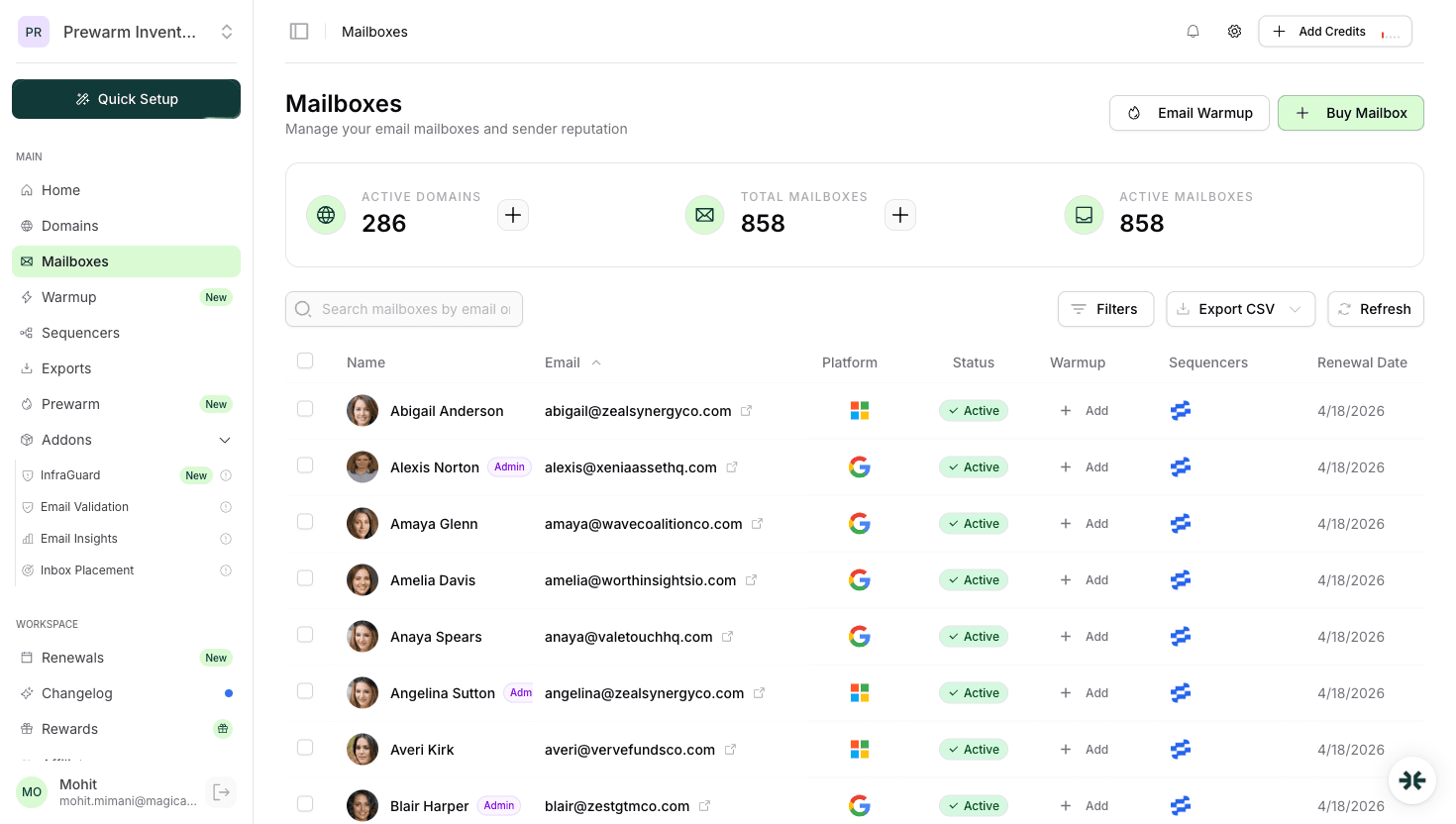
When we built InboxKit, US-based IP infrastructure was a deliberate architectural decision, not an afterthought. Here is how it works:
Google Workspace accounts on InboxKit are provisioned on US-based IP addresses. Every mailbox at $2.50/mo sends from Google's US infrastructure. This is not the cheapest way to provision accounts. US-based provisioning costs us more than routing through other regions. but the deliverability difference justifies the investment.
Microsoft 365 accounts at $2.50/mo are similarly provisioned on US/North American infrastructure. InboxKit also offers Azure mailboxes at $30/tenant (up to 100 mailboxes) on US-based infrastructure. For teams running a mix of Google, Microsoft, and Azure accounts for provider diversity, all benefit from the US IP advantage.
What this means for your deliverability:
For agencies managing client infrastructure, the math is clear: 50 Google Workspace mailboxes on InboxKit cost $149.50/mo for mailboxes plus $150/mo for warmup ($3/mailbox/mo add-on), delivering from US IPs with InfraGuard monitoring included. The same setup on a budget international provider might cost $100/mo but achieve 15-20% lower inbox placement. which means fewer replies, fewer meetings, and less revenue for your clients.
If you are running email campaigns and want to measure the IP location effect, here is how to do it:
Method 1: A/B test with placement testing If you have mailboxes on different providers (some US-based, some not), send the same email content from both and run inbox placement tests. Compare the results by provider and note the differences across Gmail, Outlook, and Yahoo.
Method 2: Google Postmaster Tools comparison If you run multiple domains, check Google Postmaster Tools for each one. Domains sending from US IPs should show higher or equal reputation compared to the same sending patterns from international IPs.
Method 3: Track campaign metrics by mailbox provider In your sequencer, segment campaign results by which mailbox sent them. If some mailboxes are on InboxKit (US IPs) and others on international providers, compare open rates and reply rates between the groups.
The bottom line: US-based IPs are not a silver bullet, but they provide a meaningful and measurable advantage for the typical email use case. At InboxKit's pricing of $2.50/mo per Google Workspace mailbox, the cost of this advantage is negligible compared to the deliverability benefit.
Yes. Our data shows 12-18% higher inbox placement rates for US-based IPs when sending to US recipients compared to international IPs with similar sending practices. The effect is strongest with Microsoft Outlook and smallest with Gmail.
Yes. All InboxKit Google Workspace and Microsoft 365 mailboxes (plans from $2.50/mailbox/mo) are provisioned on US-based IP infrastructure. This is a deliberate architectural choice for better deliverability.
Absolutely. IP location is one factor among many. Clean sending practices, proper authentication, good engagement, and consistent volume matter more. But US IPs give you a higher starting baseline that makes everything easier.
For European prospects, European IPs may perform slightly better due to the geography match. However, US IPs still perform well globally. If your audience is mixed (US + Europe), US IPs are the safer default choice.
InboxKit offers US-IP Google Workspace and Microsoft 365 with plans from $2.50/mailbox/mo (from $2.50/additional on Enterprise). Competitors offering US IPs typically charge $3.50-$5.00/mo per mailbox. Budget providers at $1-2/mo usually route through non-US infrastructure.
Free tools and pages that go with this guide.
 Guides
 Rahul LakhaneyEducationalRahul LakhaneyEducationalRahul LakhaneyGuides
 Mohit Mimani
From $2.50/mailbox/mo. No plans or slots. Automated DNS, warmup, and InfraGuard monitoring included.