LearnReviews
InfraBoxes Review 2026

By Saksham JainPublished on: May 21, 2026 · 11 min read · Last reviewed: May 2026
TL;DR
InfraBoxes (infraboxes.com) is a deliverability-first email infrastructure provider with a clean, low pricing model: $3 per private mailbox or $2.50 per Google mailbox, with warmup, monitoring, and burn protection bundled into every mailbox. The headline differentiator is bundling, the things most providers sell separately (warmup and monitoring) are included in the per-mailbox price, and private mailboxes run on dedicated stacks isolated every 10 domains. This review summarizes the provider's public claims, what we could and could not independently verify, and the operational context buyers should weigh before purchasing.
This review is based on publicly available information as of the publication date, including the InfraBoxes website (infraboxes.com) and its homepage, plus a sample of public discussion and third-party coverage. We did not independently run inbox placement tests on InfraBoxes mailboxes, did not measure suspension rates, did not benchmark the advertised 10 to 12 minute setup, and did not audit support response times. Where we describe features, pricing, or behavior, the source is the provider's own marketing or documentation unless otherwise stated.
A note on third-party validation: InfraBoxes is newer and smaller than incumbent providers. Detailed neutral coverage (large G2 / Trustpilot / Reddit aggregates) is thin, which is expected for a newcomer rather than a red flag in itself. Where the InfraBoxes homepage publishes specific deliverability figures (for example a 95%+ inbox placement claim and a 95.7% dashboard figure), those are self-reported by the provider and are not independently audited.
InboxKit, the publisher of this review, sells deliverability tooling that overlaps with parts of the InfraBoxes use case. We have made an effort to keep the analysis neutral and to clearly mark sections where InboxKit is referenced as a comparison.
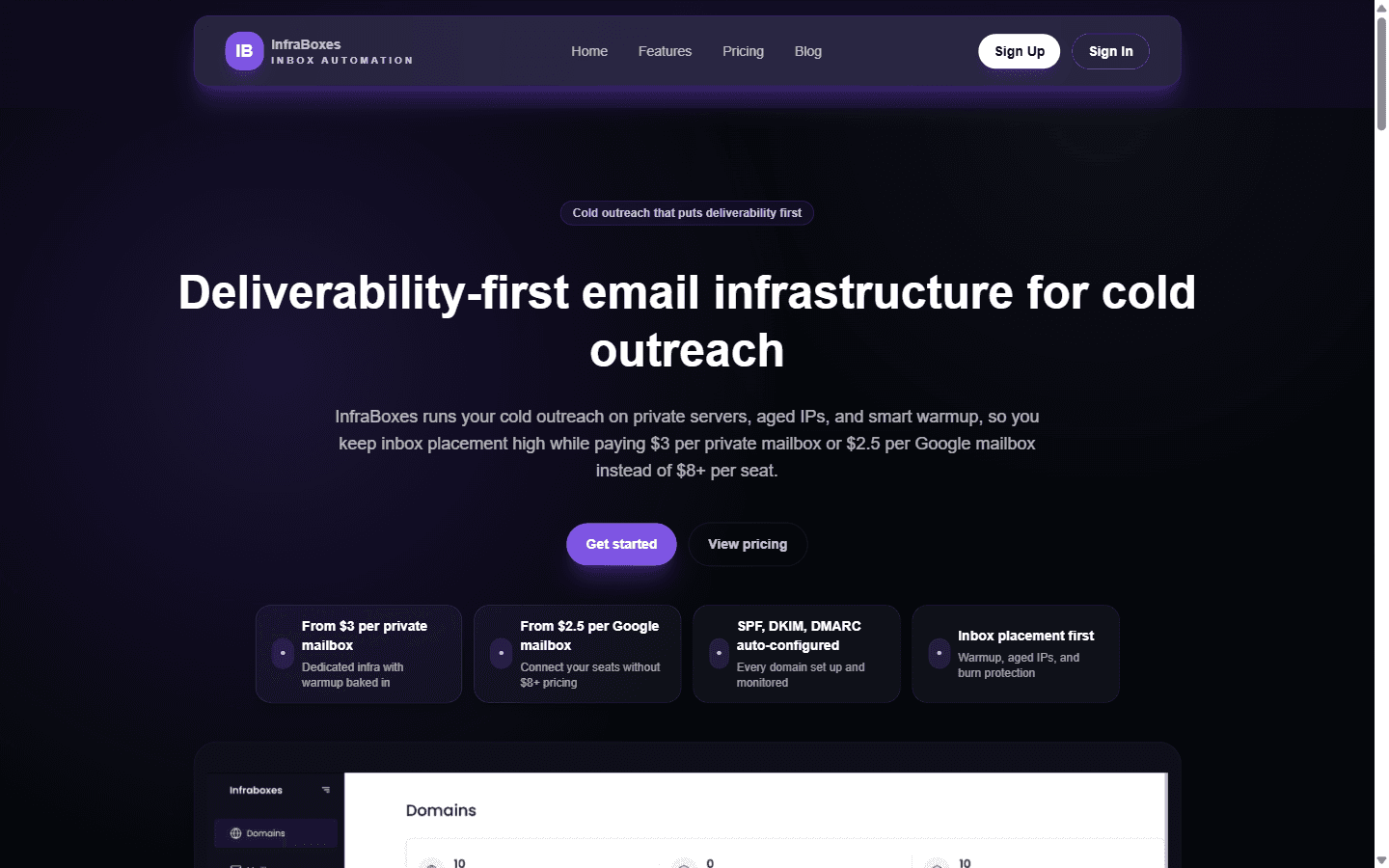
Per the provider, InfraBoxes runs cold outreach on private servers, aged IPs, and smart warmup, with positioning aimed at "teams that care more about inbox placement and cost per mailbox than fancy dashboards." The product offers two mailbox types:
The central design choice is bundling. Per the provider, warmup, monitoring, and burn protection are included in the per-mailbox price rather than sold as add-ons, and the product surfaces them through an inbox-style console that shows inbox placement, reply health, per-domain cost, and burn alerts in one view. InfraBoxes is sequencer-agnostic, the buyer plugs the mailboxes into Smartlead, Instantly, Apollo, or in-house tools, and is positioned for agencies sending 50,000 to 1,000,000+ emails per month and teams managing 20 to 200+ mailboxes.
InfraBoxes publishes a simple, transparent per-mailbox price on its homepage, plus worked cost examples at common volumes. Figures below were confirmed on the InfraBoxes homepage at the time of research.
| Mailbox type | Price / mailbox / mo | Includes (per provider) |
|---|---|---|
| Private (dedicated infrastructure) | $3 | Aged IPs, domain isolation (every 10 domains on a dedicated stack), warmup, monitoring, burn alerts |
| Google (your seats, connected) | $2.50 | Warmup, monitoring, burn alerts |
Worked cost examples published on the homepage:
| Scale | Private (per provider) | Google (per provider) |
|---|---|---|
| 30 mailboxes | $90 / month | $75 / month |
| 100 mailboxes | $300 / month | $250 / month |
A few notes on the pricing, based on the provider's pages:
The capabilities below are taken from the InfraBoxes homepage at the time of writing. We did not independently verify each item in production.
What is not described as included in the standard product, based on public materials: a long public track record, a deep neutral review aggregate, an independent audit of the published deliverability figures, or a sequencer (InfraBoxes is infrastructure, not a sending tool).
InfraBoxes' deliverability case rests on bundled architecture: aged IPs, domain isolation on private mailboxes, included warmup, dynamic rotation, bounce filtering, and burn alerts. All of those are appropriate design choices for email reputation, and bundling them into the per-mailbox price is operationally simpler than stitching together a cheap mailbox provider and a separate warmup or monitoring tool.
Considerations buyers should weigh:
We did not run independent placement tests. The structural claims are consistent with credible email-specific infrastructure providers in the category; the performance claims are best evaluated against the buyer's own measured results.
The summary below reflects publicly advertised strengths and limitations relative to other providers in the same general category at the time of writing.
Pros
Cons
Based on the advertised feature set and pricing, InfraBoxes may appeal to:
It may be a weaker fit for:
The table below summarises how InfraBoxes compares to other providers in the same general category, based on publicly available information at the time of writing. Pricing and features change frequently; verify directly with each provider.
| Provider | Advertised per-mailbox base | Monitoring included | May suit |
|---|---|---|---|
| InfraBoxes | $2.50 (Google) to $3 (private) | Yes (warmup + burn alerts) | Agencies wanting cheap mailboxes with monitoring bundled |
| InboxKit | Plan-based, from $39 / mo for 10 mailboxes | Yes (InfraGuard, real-time) | Teams wanting mailboxes plus a deeper, real-time monitoring layer |
| InfraForge | $2.50 to $4.00 + $99 per IP | Partial | High-volume teams in the Salesforge stack needing SOC 2 and dedicated IPs |
| Maildoso | from ~$1.80 | Basic | Budget high-volume SMTP |
| Mailbloom / Mailscale | flat per server | Yes (24 / 7) | Dedicated-IP isolation at volume |
| AeroSend | ~$3.10 to $4.00 per mailbox | Yes (five-metric burn alerts) | Agencies wanting managed 10-domain isolation pods |
For buyers who specifically want cheap mailboxes with bundled monitoring, InfraBoxes is one of the most direct fits in this set, and the inclusion of monitoring as a base feature is genuinely above the category baseline. For buyers whose primary need is the deepest, real-time monitoring layer paired with warmed, isolated mailboxes, a provider that bundles a dedicated monitoring stack (such as InboxKit's InfraGuard: real-time blacklist alerts, DNS drift detection, and bounce-rate alerting) is an alternative worth weighing on monitoring depth and provider track record. Disclosure: InboxKit is the publisher of this review.
Editorial rating: 7.5 / 10
Based on publicly available information, InfraBoxes is a smartly designed value play. Bundling warmup, monitoring, and burn protection into a $2.50 to $3 per-mailbox price, with the choice of dedicated private infrastructure or connected Google seats under one provider, undercuts the common "cheap mailbox plus expensive warmup tool" stack, and the underlying deliverability architecture (aged IPs, per-stack isolation every 10 domains, dynamic IP rotation, bounce filtering) is genuinely sound. For cost-conscious agencies that want monitoring included rather than upsold, it is a strong option.
The rating is held below a higher score primarily by: (a) self-reported deliverability claims that are not independently audited; (b) a newer / smaller provider footprint with a thin public track record; (c) the usual dedicated-infrastructure volume caveat on the private option; and (d) the absence of a public SOC 2 attestation on the homepage.
We did not independently test InfraBoxes deliverability, suspension rates, or support response times. Buyers should treat this review as a structured summary of public information rather than a substitute for their own evaluation.
Readers comparing the same mailbox-plus-monitoring model with a deeper, real-time monitoring stack can see how InboxKit positions itself.
Per the InfraBoxes homepage at the time of research, the pricing is $3 per private mailbox or $2.50 per Google mailbox per month, with warmup, monitoring, and burn alerts included on every mailbox. Worked cost examples on the homepage put 30 mailboxes at $90 / $75 (private / Google) and 100 mailboxes at $300 / $250 per month, with no separate warmup subscription required.
Per the provider, setup (SPF, DKIM, DMARC), warmup, monitoring, and burn alerts are all included in the per-mailbox price. Private mailboxes additionally include aged IPs and per-stack isolation, every 10 domains live on their own dedicated stack. No separate warmup or monitoring subscription is required.
Per the provider, yes. InfraBoxes is infrastructure-first and sequencer-agnostic, and connects mailboxes to Smartlead, Instantly, Apollo, or in-house tools. A sequencer is a separate subscription on top of the mailbox price.
No. The 95%+ inbox placement claim and the 95.7% dashboard figure on the InfraBoxes homepage are self-reported by the provider and are not independently audited. The underlying architecture (aged IPs, per-stack isolation every 10 domains, warmup, burn alerts) supports good placement, but buyers should validate with their own sending against their own list.
Per the provider's pricing, the Google option ($2.50 per mailbox) suits lower-volume senders and audiences that prefer Google-origin mail, since reputation behaviour is shared with the broader Google Workspace pool. The private option ($3 per mailbox, dedicated infrastructure with per-stack isolation) suits higher-volume buyers who can keep dedicated IPs busy and want isolation between domain blocks.
Free tools and pages that go with this guide.
From $2.50/mailbox/mo. No plans or slots. Automated DNS, warmup, and InfraGuard monitoring included.