LearnReviews
AeroSend Review 2026

By Saksham JainPublished on: May 20, 2026 · Updated: Sep 6, 2026 · 11 min read · Last reviewed: Sep 2026
TL;DR
AeroSend is an email infrastructure provider that advertises private, isolated infrastructure, with every 10 domains placed on their own dedicated servers and IPs, paired with automated "domain burn alerts." Publicly advertised pricing is slot-based, starting at $120 per month for a 10-domain slot (30 mailboxes) and dropping to $93 per slot at higher volume. This review summarizes the provider's public claims, what we could and could not independently verify, and the operational context buyers should weigh before purchasing.
This review is based on publicly available information as of the publication date, including the AeroSend website (aerosend.io) and its pricing page, plus a sample of public discussion and third-party coverage. We did not independently run inbox placement tests on AeroSend mailboxes, did not measure suspension rates, did not benchmark setup time, did not stress-test the advertised domain burn alerts, and did not audit support response times. Where we describe features, pricing, or behavior, the source is the provider's own marketing or documentation unless otherwise stated.
A note on third-party coverage: many of the detailed AeroSend writeups currently surfacing in search are published by competing providers that run alternatives or comparison pages. We treat competitor-authored coverage with appropriate caution and rely on AeroSend's own pages as the primary source for advertised claims.
InboxKit, the publisher of this review, sells deliverability tooling that overlaps with parts of the AeroSend use case. We have made an effort to keep the analysis neutral and to clearly mark sections where InboxKit is referenced as a comparison.
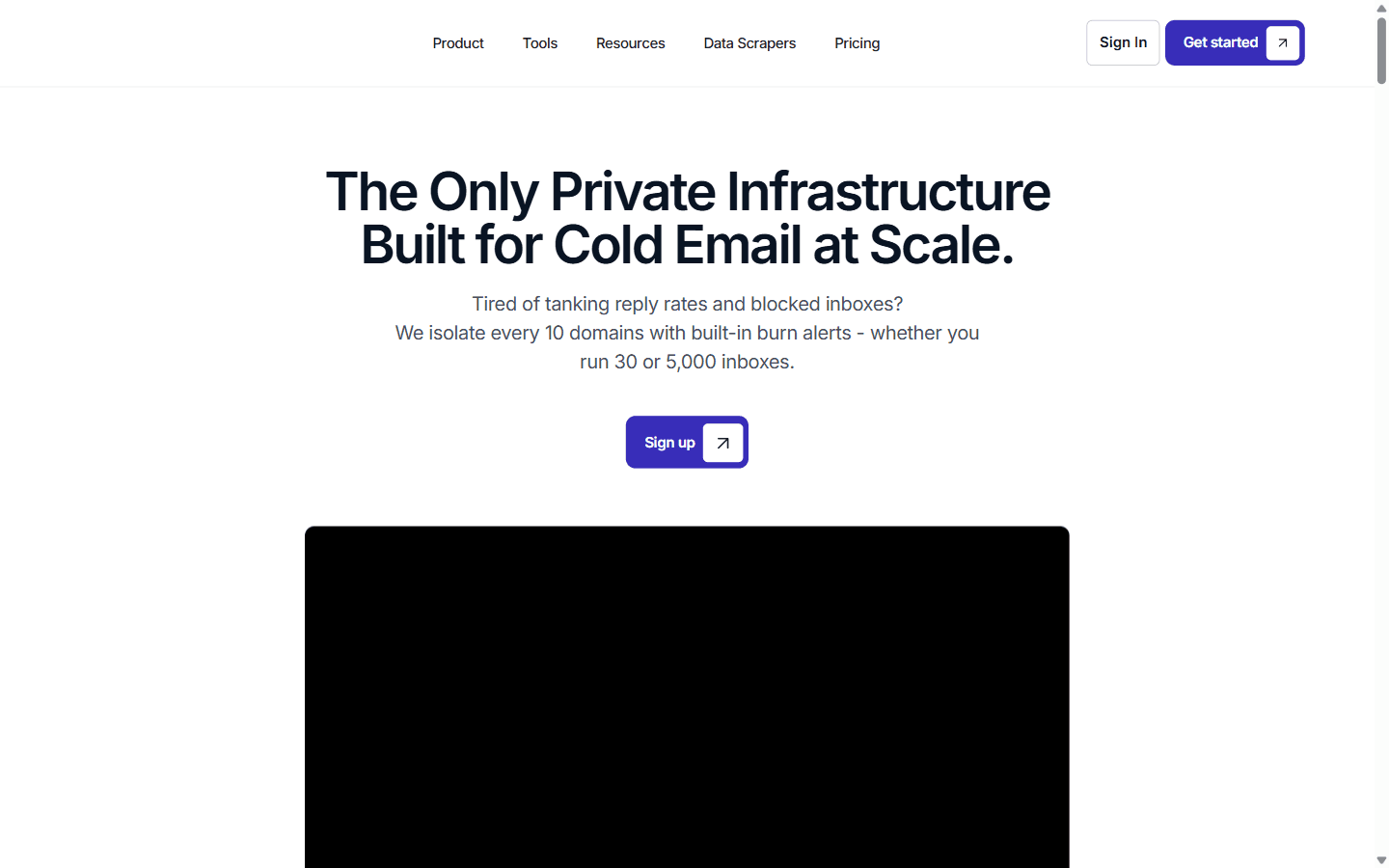
AeroSend is an email infrastructure provider that positions itself around private, isolated sending infrastructure for outbound campaigns. According to the AeroSend homepage, the product is built specifically for email rather than general business mail, with positioning language such as "private infrastructure built for email at scale." It is not a sequencer; the provider markets mailboxes and infrastructure that a buyer connects to a separate sending tool.
The central concept, stated on the homepage under an "Isolation by Design" heading, is that each batch of 10 domains runs on its own dedicated infrastructure (dedicated servers and IPs). Per the provider, this is why orders are sold in 10-domain slots: each slot stands up a separate isolation "pod" so that one burned domain or a bad neighbor does not affect the rest of a buyer's sending.
The second pillar is monitoring. AeroSend advertises automated "domain burn alerts" that watch each domain across five named metrics and warn the operator before deliverability declines. The company is led by founder Namit Jindal (Founder and CEO); public materials also reference a co-founder, Prabhu Rengaswamy (CTO). AeroSend describes itself as founded in 2024 and launched in 2025, and markets hands-on, founder-led support. We did not independently verify the identity, role, or current involvement of any individual, or the company's stated scale (the site references serving 150+ agencies), and we treat those figures as provider marketing claims.
Publicly advertised AeroSend pricing is slot-based: buyers purchase capacity in 10-domain slots, with 3 mailboxes per domain, so a single 10-domain slot equals 30 mailboxes. Pricing is volume-banded across three tiers, sourced from the AeroSend pricing page at the time of research.
| Tier (advertised band) | Price per 10-domain slot / month | Effective per mailbox | What the tier adds |
|---|---|---|---|
| Starter (first ~100 domains) | $120 | ~$4.00 | Isolated infrastructure, managed warmup, biweekly placement tests, domain burn alerts |
| Growth (~101 to 300 domains) | $105 | ~$3.50 | Adds campaign-creation support, lead-list brainstorm, lead-database access (per provider) |
| Scale (~301+ domains) | $93 | ~$3.10 | Adds a dedicated Slack channel and priority support (per provider) |
A few notes on the pricing, based on the provider's pages:
The feature list below is taken from the AeroSend homepage and pricing page at the time of writing. We did not independently verify each item in production.
What is not described as included in the standard product, based on public materials: a sequencer, a true lead-enrichment engine in the Apollo or Clay sense, or Google Workspace and Microsoft 365 mailboxes (AeroSend is private infrastructure, not a mainstream-mailbox reseller). We did not locate a published SOC 2 or other formal compliance attestation on the site; buyers in regulated industries should verify directly.
AeroSend's deliverability case rests on its architecture and its monitoring, both of which are advertised here rather than independently audited.
Considerations buyers should weigh:
We did not run independent placement tests. The structural claims are consistent with credible private-infrastructure providers in the category; the performance claims are best evaluated against the buyer's own measured results.
The summary below reflects publicly advertised strengths and limitations relative to other providers in the same general category at the time of writing.
Pros
Cons
Based on the advertised feature set and pricing, AeroSend may appeal to:
It may be a weaker fit for:
The table below summarizes how AeroSend compares to other providers in the same general category, based on publicly available information at the time of writing. Pricing and features change frequently; verify directly with each provider.
| Provider | Advertised model / per mailbox | Isolation / monitoring (per provider) | May suit |
|---|---|---|---|
| AeroSend | Slot-based, ~$3.10 to $4.00 per mailbox | 10-domain pods plus five-metric burn alerts | Agencies wanting managed isolation plus monitoring |
| InboxKit | Plan-based, from $39 / mo for 10 mailboxes | Bundled InfraGuard monitoring | Teams wanting mailboxes plus bundled monitoring |
| InfraForge | Slot-based, ~$2.50 to $4.00 per mailbox | Dedicated IPs as a paid add-on; SOC 2 referenced | High-volume teams in the Salesforge stack |
| MailReef | Per-server (dedicated SMTP) | One dedicated IP per server | High-volume senders wanting a dedicated IP |
| Premium Inboxes | Per-inbox, ~$2.80 to $4.50 | Active monitoring on the Insured tier | Teams wanting a high-touch service model |
| CheapInboxes | Per-inbox, ~$2.80 to $3.50 | Not advertised | Budget-conscious teams with their own stack |
For buyers who specifically want private, isolated infrastructure, AeroSend and InfraForge are the closest matches in this set. For buyers whose main interest is the monitoring layer, catching a burning domain before it spreads, a provider that bundles mailboxes with deliverability monitoring (such as InboxKit's InfraGuard: blacklist alerts, DNS drift detection, and bounce-rate alerting) is an alternative worth weighing. Disclosure: InboxKit is the publisher of this review.
Editorial rating: 7 / 10
Based on publicly available information, AeroSend is a credibly designed, email-specific infrastructure product. The advertised per-pod isolation, aged IPs, dynamic rotation, and five-metric domain burn alerts are sensible engineering choices, the pricing is posted transparently on the pricing page, and the founder-led support model is a real differentiator for buyers who value it.
The rating is held below a higher score primarily by: (a) thin independent validation, namely a single-digit G2 review count at the time of research, little Reddit presence, and several detailed third-party writeups authored by competitors; (b) self-reported, un-audited deliverability outcomes; (c) the absence of a free trial and a 10-domain (30-mailbox) minimum that excludes smaller buyers; and (d) no public SOC 2 attestation located on the site. We also note that some older third-party pages list tier prices that do not match AeroSend's current pricing page.
We did not independently test AeroSend deliverability, suspension rates, or support response times. Buyers should treat this review as a structured summary of public information rather than a substitute for their own evaluation.
Readers comparing options that bundle the mailbox layer with independent deliverability monitoring under one plan can see how InboxKit positions itself.
Publicly advertised AeroSend pricing is slot-based, sold in 10-domain slots of 30 mailboxes (3 mailboxes per domain). Per the pricing page at the time of research: roughly $120 per slot per month at the Starter band (about $4.00 per mailbox), $105 at the Growth band (about $3.50 per mailbox), and $93 at the Scale band (about $3.10 per mailbox). Domains are a separate cost (the provider references roughly $12 per year), and no free trial is advertised. Some older third-party pages cite tier prices that do not match the current page, so confirm live numbers with the provider.
Per the provider, domain burn alerts are notifications generated by monitoring five domain metrics, namely warmup reputation, inbox placement, reply rate, bounce rate, and bounce type, that warn a buyer to slow sending or replace a domain before deliverability declines. We did not independently test how the alerts are generated or how accurate they are; the description here reflects AeroSend's own materials.
No. Per the provider, AeroSend is the mailbox and infrastructure layer, not a sending tool. It advertises compatibility with sequencers including Smartlead, Instantly, lemlist, Woodpecker, Reply.io, Saleshandy, HubSpot Sales, and Mailshake, each of which is a separate subscription.
No free trial is advertised on the AeroSend site at the time of research. Buyers commit to at least one 10-domain slot (30 mailboxes) before sending. The provider references cancel-anytime contract terms, which is separate from the 10-domain slot minimum.
AeroSend advertises private, isolated infrastructure (10-domain pods on dedicated servers and IPs) plus five-metric domain burn alerts, priced per slot with no free trial and a 30-mailbox minimum. InboxKit uses a plan-based model that includes a fixed mailbox count (10 mailboxes from $39 per month) and bundles InfraGuard monitoring (blacklist checks, DNS drift detection, and bounce-rate alerts) into the standard plan. They are different shapes; buyers should weigh dedicated-infrastructure isolation against bundled monitoring at a lower entry commitment. Disclosure: InboxKit is the publisher of this review.
Free tools and pages that go with this guide.
From $2.50/mailbox/mo. No plans or slots. Automated DNS, warmup, and InfraGuard monitoring included.