LearnReviews
Lunatro MX Review 2026

By Saksham JainPublished on: May 21, 2026 · 10 min read · Last reviewed: May 2026
TL;DR
LUNATRO.MX (lunatro.mx) is a newer email infrastructure provider built on Microsoft Azure, with a clean, aggressive entry offer: $199 per month for a subscription that includes 4 pre-configured domains, 100 inboxes per domain (400 total), and an allowance of up to 30,000 emails per month. The verdict up front: the inbox-count headline is striking, but the binding constraint is the 30,000-email monthly cap, which works out to roughly 1,000 sends per day for $199 per month. This review summarizes the provider's public claims, what we could and could not independently verify, and the operational context buyers should weigh before purchasing.
This review is based on publicly available information as of the publication date, including the LUNATRO.MX website (lunatro.mx) and its homepage, plus a sample of third-party coverage. We did not independently run inbox placement tests on Lunatro mailboxes, did not measure suspension rates, did not benchmark the advertised 24-hour setup, and did not audit support response times. Where we describe features, pricing, or behavior, the source is the provider's own marketing or documentation unless otherwise stated.
A note on third-party validation: Lunatro is new. The on-site testimonials are positive and identify named operators, but the independent neutral footprint (G2, Trustpilot, large Reddit threads) is thin, which is expected for a newcomer rather than a red flag in itself. Several third-party comparison writeups are authored by competing providers, which we weigh accordingly.
InboxKit, the publisher of this review, sells deliverability tooling that overlaps with parts of the Lunatro use case. We have made an effort to keep the analysis neutral and to clearly mark sections where InboxKit is referenced as a comparison.
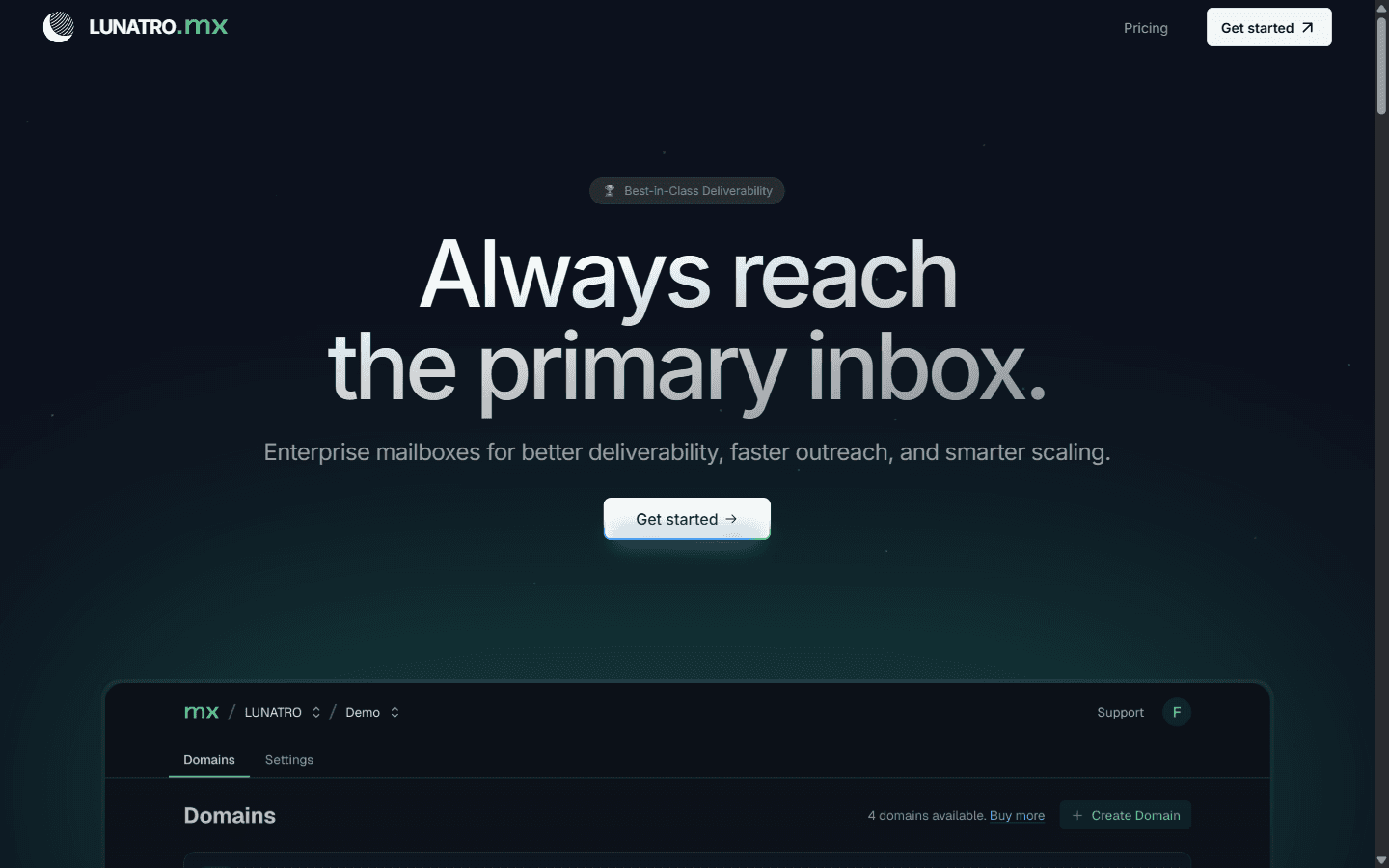
Per the provider, LUNATRO.MX is an "enterprise mailboxes for better deliverability" service built on Microsoft Azure-hosted IPs, with premium IPs and proper warmup, aimed at email professionals, agencies, startups, and SMBs. Access is gated: the homepage describes access as "limited to qualified email professionals," with an application flow via a scheduled call.
The pricing model is subscription-based and high-density. Each subscription, per the provider, includes 4 domains, 100 inboxes per domain (400 total), and an allowance of up to 30,000 emails per month, with the inbox set fully configured (SPF, DKIM, DMARC) within 24 hours and direct support via a Slack channel. The provider references compatibility with sequencers including EmailBison, Smartlead, and Instantly. Buyers scale by stacking additional subscriptions.
The high inbox-per-domain density (100 inboxes per domain) puts Lunatro in the same conceptual category as Slicey: lots of Microsoft inboxes per domain to drive down per-inbox cost, with the same structural trade-off (concentration of risk per domain).
LUNATRO.MX publishes a single, simple plan on its homepage. Figures below were confirmed on the Lunatro homepage at the time of research.
| Item | Per subscription |
|---|---|
| Price | $199 / month |
| Domains | 4, pre-configured for email |
| Inboxes | 100 per domain (400 total) |
| Email allowance | Up to 30,000 per month |
| Infrastructure | Microsoft Azure-hosted IPs (US-based) |
| Setup | ~24 hours, with SPF, DKIM, DMARC pre-configured |
| Support | Slack channel |
| Scaling | Stack additional subscriptions |
A few notes on the pricing, based on the provider's pages:
The capabilities below are taken from the LUNATRO.MX homepage at the time of writing. We did not independently verify each item in production.
What is not described as included in the standard product, based on public materials: a deeper deliverability-monitoring console (blacklist, DNS drift, burn alerts) at the level of a dedicated tool, Google Workspace mailboxes, or a published SOC 2 attestation. Buyers in regulated industries should verify any compliance requirements directly.
Lunatro's deliverability case rests on Microsoft Azure infrastructure, premium IPs, conservative monthly send caps, and a warmup protocol, all advertised here rather than independently audited. The provider's homepage references named operators and clients reaching decision makers at brands such as Sky, ZARA, DJI, and Metro Goldwyn Mayer, with on-site testimonials from operators including Jamie Crichton (NuOpp) and Aron Gebe (TomorrowLab).
Considerations buyers should weigh:
We did not run independent placement tests. The structural claims are consistent with credible Microsoft / Azure email providers in the category; the performance claims are best evaluated against the buyer's own measured results.
The summary below reflects publicly advertised strengths and limitations relative to other providers in the same general category at the time of writing.
Pros
Cons
Based on the advertised feature set and pricing, Lunatro may appeal to:
It may be a weaker fit for:
The table below summarises how Lunatro compares to other providers in the same general category, based on publicly available information at the time of writing. Pricing and features change frequently; verify directly with each provider.
| Provider | Advertised model / entry | Platform (per provider) | May suit |
|---|---|---|---|
| LUNATRO.MX | $199 / mo per subscription (30k sends, 400 inboxes) | Microsoft Azure, high-density | Cheap Azure capacity for Outlook-heavy senders |
| InboxKit | Plan-based, from $39 / mo for 10 mailboxes | Warmed mailboxes plus bundled InfraGuard monitoring | Teams wanting mailboxes plus bundled monitoring at a lower entry commitment |
| Slicey | Per-inbox (quote) | Microsoft, high-density | Outlook-heavy senders wanting cheapest inbox count |
| HyperTide | Per-inbox | Microsoft / Azure | Azure Entra specialists |
| ScaledMail | ~$2 (Outlook) | Multi-provider managed | Done-for-you Google / Outlook / SMTP mix |
| InfraBoxes | ~$2.50 (Google) to $3 (private) | Google or private | Cost-conscious agencies wanting monitoring included |
For buyers who specifically want cheap Microsoft / Azure capacity for Outlook-heavy audiences, Lunatro, Slicey, and HyperTide are the closest matches in this set. Because Lunatro is new and high-density, the sensible risk mitigant is monitoring, an early-warning layer for domains starting to burn before they take a batch of inboxes with them. That is the gap InboxKit's InfraGuard fills (real-time blacklist alerts, DNS drift detection, and bounce-rate alerting), which is worth pairing with any newer, high-density provider under trial. Disclosure: InboxKit is the publisher of this review.
Editorial rating: 7 / 10
Based on publicly available information, LUNATRO.MX is a cleanly designed, genuinely cheap Microsoft / Azure email infrastructure option. The $199-for-roughly-1,000-sends-per-day economics are strong on a sends-per-dollar basis, the 24-hour setup with SPF, DKIM, and DMARC pre-configured is operationally simple, and the application gate lets a buyer confirm fit before committing.
The rating is held below a higher score primarily by: (a) newcomer risk, with a thin independent review footprint and limited public history; (b) the high inbox-per-domain density (100 per domain) that concentrates risk if a domain is flagged; (c) the 30,000-email monthly cap that means scaling volume scales spend linearly through additional subscriptions; and (d) the absence of a deeper, in-platform deliverability-monitoring layer (blacklist, DNS drift, burn alerts) at the level of a dedicated tool.
We did not independently test Lunatro deliverability, suspension rates, or support response times. Buyers should treat this review as a structured summary of public information rather than a substitute for their own evaluation, and pair any newer, high-density provider with independent monitoring before scaling.
Readers comparing low-cost capacity options that also bundle a real-time deliverability safety net can see how InboxKit positions itself.
Per the Lunatro homepage at the time of research, the plan is $199 per month per subscription, which includes 4 pre-configured domains, 100 inboxes per domain (400 total), and an allowance of up to 30,000 emails per month, with the inbox set fully configured (SPF, DKIM, DMARC) within roughly 24 hours. Buyers scale by stacking additional subscriptions.
Per the provider, up to 30,000 emails per month per subscription, which works out to roughly 1,000 sends per day. The 400 inboxes per subscription provide rotation headroom rather than additional sending capacity; buyers needing more volume add subscriptions.
Microsoft. Per the provider, Lunatro uses Microsoft Azure-hosted IPs (US-based), which suits Outlook-heavy and enterprise audiences. Broad consumer email tends to be harder to keep healthy on Microsoft than on Google, so buyers should match the platform to their target audience.
Per the provider, Lunatro is a real, functioning Microsoft / Azure-based provider with positive on-site testimonials from named operators and a publicly stated client list reaching decision makers at brands including Sky, ZARA, DJI, and Metro Goldwyn Mayer. As a newcomer, the independent neutral review footprint is still thin; buyers should run a test batch against their own list before scaling.
Per the provider, yes. Access is gated and "limited to qualified email professionals," with onboarding via a scheduled qualification call. That removes instant self-serve start but lets the buyer confirm fit on the call before committing to the $199 per month subscription.
Free tools and pages that go with this guide.
From $2.50/mailbox/mo. No plans or slots. Automated DNS, warmup, and InfraGuard monitoring included.