LearnReviews
ScaledMail Review 2026

By Saksham JainPublished on: May 20, 2026 · Updated: Sep 6, 2026 · 11 min read · Last reviewed: Sep 2026
TL;DR
ScaledMail is a fully-managed email infrastructure provider whose distinguishing feature is letting buyers blend Google Workspace, Microsoft Outlook, and SMTP mailboxes in one volume-sized package that the ScaledMail team builds and runs. Publicly advertised pricing is per provider: $3.50 per Google mailbox, $50 per Outlook domain (25 mailboxes), and $3.75 per SMTP domain (4 mailboxes), with reporting as a paid add-on. This review summarizes the provider's public claims, what we could and could not independently verify, and the operational context buyers should weigh before purchasing.
This review is based on publicly available information as of the publication date, including the ScaledMail website (scaledmail.com) and its pricing page, plus third-party coverage and review aggregators. We did not independently run inbox placement tests on ScaledMail mailboxes, did not measure suspension rates, did not benchmark setup time, did not stress-test warmup depth, and did not audit support response times. Where we describe features, pricing, or behavior, the source is the provider's own marketing or documentation unless otherwise stated.
A few notes on sourcing. Public ratings cited by third-party aggregators (for example a G2 figure around 4.7 out of 5 and a Trustpilot figure around 4.6 out of 5) could not be confirmed directly during research because the review pages returned access errors to automated retrieval; buyers should open those pages manually before relying on the numbers. ScaledMail is associated with Beanstalk Consulting, which is relevant context for some legacy packaged-plan figures that appear in third-party writeups but not on the current per-unit pricing page.
InboxKit, the publisher of this review, sells deliverability tooling that overlaps with parts of the ScaledMail use case. We have made an effort to keep the analysis neutral and to clearly mark sections where InboxKit is referenced as a comparison.
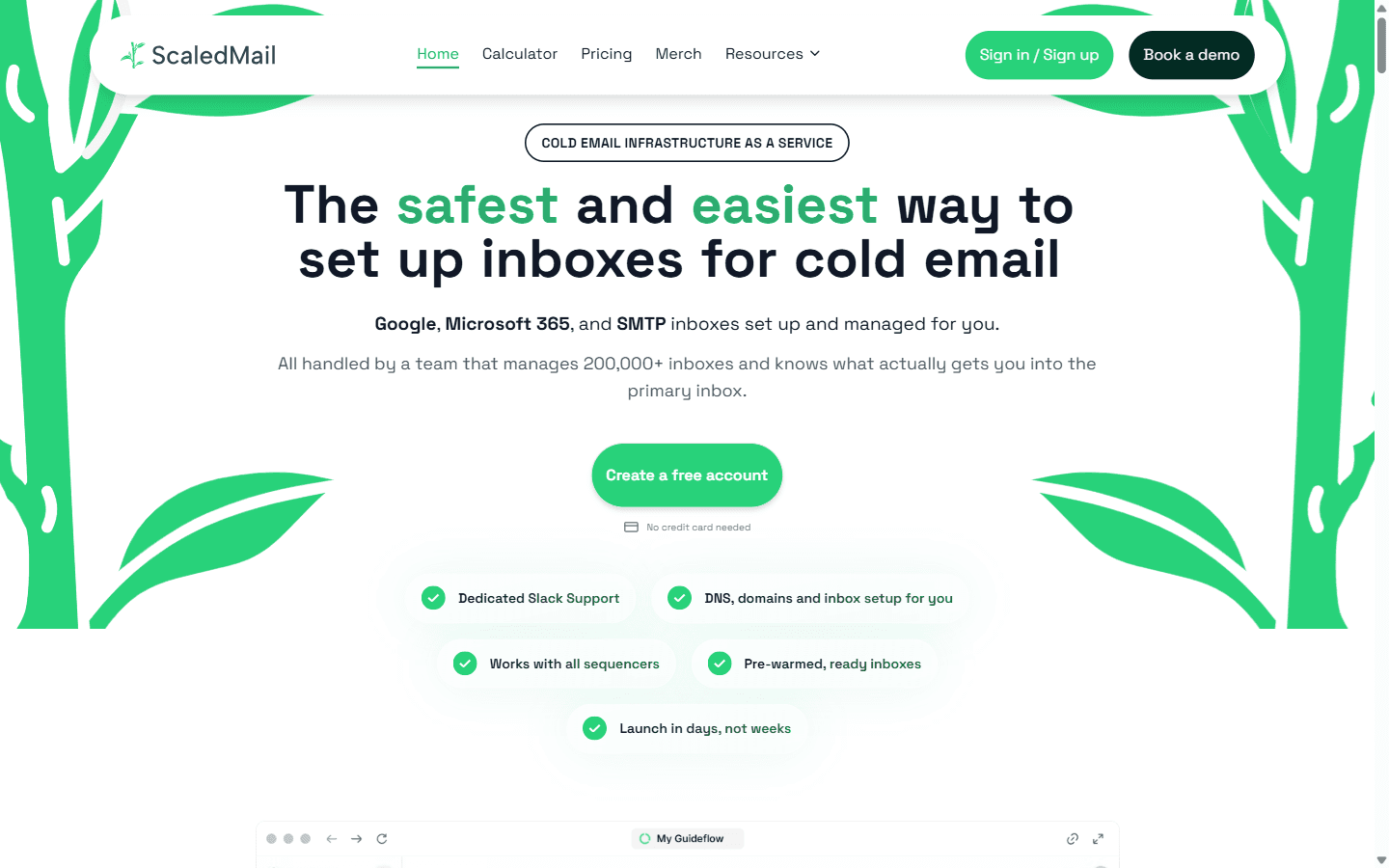
ScaledMail is an email infrastructure provider that markets "fully managed, pre-warmed mailboxes with complete DNS authentication." Per the provider, a buyer specifies a sending target and which providers they want; ScaledMail then registers domains, configures SPF, DKIM, and DMARC, provisions mailboxes, runs warmup, and monitors deliverability. The provider describes setup as taking around two to four business days and states it manages 200,000+ inboxes (a volume figure, not a customer count; some third-party writeups cite an agency count that we could not confirm on the site).
The defining feature is the multi-provider mix. Most providers lock a buyer into one mailbox type; ScaledMail advertises blending three:
The model is white-glove by design: the provider emphasizes a team-built, operator-run setup with a dedicated Slack channel rather than a heavy self-serve dashboard. Buyers connect the finished mailboxes to their own sequencer (such as Smartlead or Instantly) and send from there. We did not find isolated-tenant language on the current site, so we do not assert it as a provider claim.
ScaledMail prices per provider, and a buyer builds a package around a target volume. Warmup, DNS, provisioning, and ongoing monitoring are advertised as included in the base; reporting is a paid add-on. Figures below were confirmed on the ScaledMail pricing page at the time of research.
| Provider | Base price | Mailboxes / domain | Send cap / mailbox / day | Reporting add-on |
|---|---|---|---|---|
| Google Workspace ("Most Popular") | $3.50 / mailbox / mo | 2 to 3 | up to 25 | $2 / mailbox / mo |
| Microsoft Outlook | $50 / domain / mo | 25 | up to 10 | $5 / domain / mo |
| SMTP Server | $3.75 / domain / mo | 4 | up to 10 | $2 / mailbox / mo |
The per-provider economics matter more than the headline numbers, because the providers pack mailboxes differently:
ScaledMail's own worked example on the pricing page, 2,000 emails per day split evenly across all three providers, comes to 42 domains and 218 mailboxes at $397.75 per month base (about $1.83 per mailbox effective), plus roughly $256 per month if reporting is added on every account. That blended rate is competitive at scale, driven by the cheaper Outlook and SMTP tiers.
Two honest notes on price:
The capabilities below are taken from the ScaledMail homepage and pricing page at the time of writing. We did not independently verify each item in production.
What is not part of the standard model, based on public materials: a granular self-serve dashboard, instant self-provisioning and decommissioning, or a sequencer (buyers bring their own sending tool). We did not locate a published SOC 2 or other formal compliance attestation on the current site; buyers in regulated industries should verify directly.
ScaledMail's deliverability case rests on the underlying mailbox quality, the multi-provider design, and managed warmup plus monitoring, advertised here rather than independently audited.
Considerations buyers should weigh:
We did not run independent placement tests. The structural claims (real Google Workspace and Microsoft mailboxes, full DNS authentication, managed warmup) are consistent with credible providers in the category; the performance claims are best evaluated against the buyer's own measured results.
The summary below reflects publicly advertised strengths and limitations relative to other providers in the same general category at the time of writing.
Pros
Cons
Based on the advertised feature set and pricing, ScaledMail may appeal to:
It may be a weaker fit for:
The table below summarizes how ScaledMail compares to other providers in the same general category, based on publicly available information at the time of writing. Pricing and features change frequently; verify directly with each provider.
| Provider | Advertised model / per mailbox | Self-serve vs managed | May suit |
|---|---|---|---|
| ScaledMail | Per provider, ~$0.94 to $3.50 per mailbox | Fully managed, multi-provider | Agencies wanting a done-for-you Google / Outlook / SMTP mix |
| InboxKit | Plan-based, from $39 / mo for 10 mailboxes | Self-serve plus bundled monitoring | Teams wanting mailboxes plus InfraGuard monitoring with control |
| Premium Inboxes | Per-inbox, ~$2.80 to $4.50 | Managed, founder-in-Slack | Teams wanting a high-touch service model |
| Slicey | Per domain (~$1 per inbox advertised) | Managed, Microsoft-first | Outlook-heavy senders wanting low per-inbox cost |
| CheapInboxes | Per-inbox, ~$2.80 to $3.50 | Self-serve | Budget-conscious teams with their own stack |
For buyers who specifically want someone else to build and run multi-provider infrastructure, ScaledMail's managed model is a credible fit. For buyers who would rather keep control, see the metrics without a separate reporting fee, and get real-time deliverability monitoring built into a self-serve product, a provider that bundles mailboxes with monitoring (such as InboxKit's InfraGuard: blacklist alerts, DNS drift detection, and bounce-rate alerting) is an alternative worth weighing. Disclosure: InboxKit is the publisher of this review.
Editorial rating: 7.5 / 10
Based on publicly available information, ScaledMail does two things genuinely well: it lets a buyer blend Google, Outlook, and SMTP mailboxes into one volume-sized package, and it removes the operational burden by building and running everything for them. The advertised setup speed, the multi-provider economics, and the dedicated Slack support are real operational advantages for agencies that want to offload infrastructure.
The rating is held below a higher score primarily by: (a) the managed model itself, which trades away a self-serve dashboard and gates detailed telemetry behind a paid reporting add-on; (b) contested pre-warming depth in some third-party reviews; (c) the absence of a public SOC 2 attestation on the current site; and (d) lower send caps on the cheaper Outlook and SMTP tiers. We also note that some third-party writeups cite legacy packaged plans and minimums that do not match the current per-unit pricing page.
We did not independently test ScaledMail deliverability, suspension rates, or support response times, and we could not directly confirm the third-party review-aggregator ratings. Buyers should treat this review as a structured summary of public information rather than a substitute for their own evaluation.
Readers comparing options that bundle the mailbox layer with independent deliverability monitoring in a self-serve product can see how InboxKit positions itself.
Per the provider's pricing page at the time of research, ScaledMail prices per provider: $3.50 per Google mailbox per month (2 to 3 mailboxes per domain, up to 25 sends per day), $50 per Outlook domain per month (25 mailboxes, up to 10 sends per day), and $3.75 per SMTP domain per month (4 mailboxes, up to 10 sends per day). Warmup, DNS, and monitoring are included in the base; reporting is a paid add-on ($2 per mailbox for Google and SMTP, $5 per domain for Outlook). The provider's own worked example for 2,000 emails per day comes to about $397.75 per month base.
Per the provider, yes: ScaledMail describes mailboxes as pre-warmed and warmup as included in the base package. The site also recommends around two weeks of warmup, and some third-party reviews question the depth of the pre-warming, so confirm the warmup window for a given launch and ramp new mailboxes gradually.
Not in the granular sense. Per the provider, ScaledMail is a managed service: the team provisions and maintains the infrastructure, and the buyer gets a dedicated Slack channel rather than a console for instant self-provisioning. Detailed per-account reporting is available as a paid add-on.
The current homepage offers a free account with no credit card required, so a flat "no free trial" is no longer accurate. The per-unit pricing page does not describe a separate trial, and some third-party writeups reference legacy packaged plans or minimums; verify the current entry terms directly with the provider.
Yes, that is ScaledMail's core feature. Per the provider, a buyer builds a package blending Google Workspace, Microsoft Outlook, and SMTP mailboxes sized to a target volume, typically placing reply-sensitive campaigns on Google (higher send cap, commonly stronger placement) and routing higher-volume sending to the cheaper Outlook and SMTP tiers.
Free tools and pages that go with this guide.
From $2.50/mailbox/mo. No plans or slots. Automated DNS, warmup, and InfraGuard monitoring included.