LearnReviews
MailPool AI Review 2026

By Saksham JainPublished on: May 21, 2026 · Updated: Sep 6, 2026 · 11 min read · Last reviewed: Sep 2026
TL;DR
MailPool (mailpool.ai) is an email infrastructure platform built around one strength: creating and managing inboxes across multiple providers, its own shared network, Google Workspace, Microsoft 365, or dedicated servers, from a single no-code dashboard with automated authentication and blacklist monitoring. The platform is an official Google Cloud and Microsoft Partner, with publicly stated scale of 3,000+ customers, 35,000+ domains managed, and 250,000+ inboxes created. Pricing is volume-based and varies by inbox provider rather than a single flat rate. This review summarizes the provider's public claims, what we could and could not independently verify, and the operational context buyers should weigh before purchasing.
This review is based on publicly available information as of the publication date, including the MailPool website (mailpool.ai) and its homepage, plus a sample of third-party coverage. We did not independently run inbox placement tests on MailPool inboxes, did not measure suspension rates, did not benchmark the advertised ~5-minute setup time, and did not audit support response times. Where we describe features, pricing, or behavior, the source is the provider's own marketing or documentation unless otherwise stated.
A note on third-party validation: MailPool is one of the more established providers in this tier, with publicly stated scale (3,000+ customers, 35,000+ domains, 250,000+ inboxes) and a referenced Google Cloud and Microsoft partner status. Independent neutral coverage is more substantive than for many micro-niche providers, though some third-party reviewers have specifically questioned whether the platform's "AI" branding translates into measurable deliverability improvements over standard setups. We weigh that as fair editorial caution, not a verdict.
InboxKit, the publisher of this review, sells deliverability tooling that overlaps with parts of the MailPool use case. We have made an effort to keep the analysis neutral and to clearly mark sections where InboxKit is referenced as a comparison.
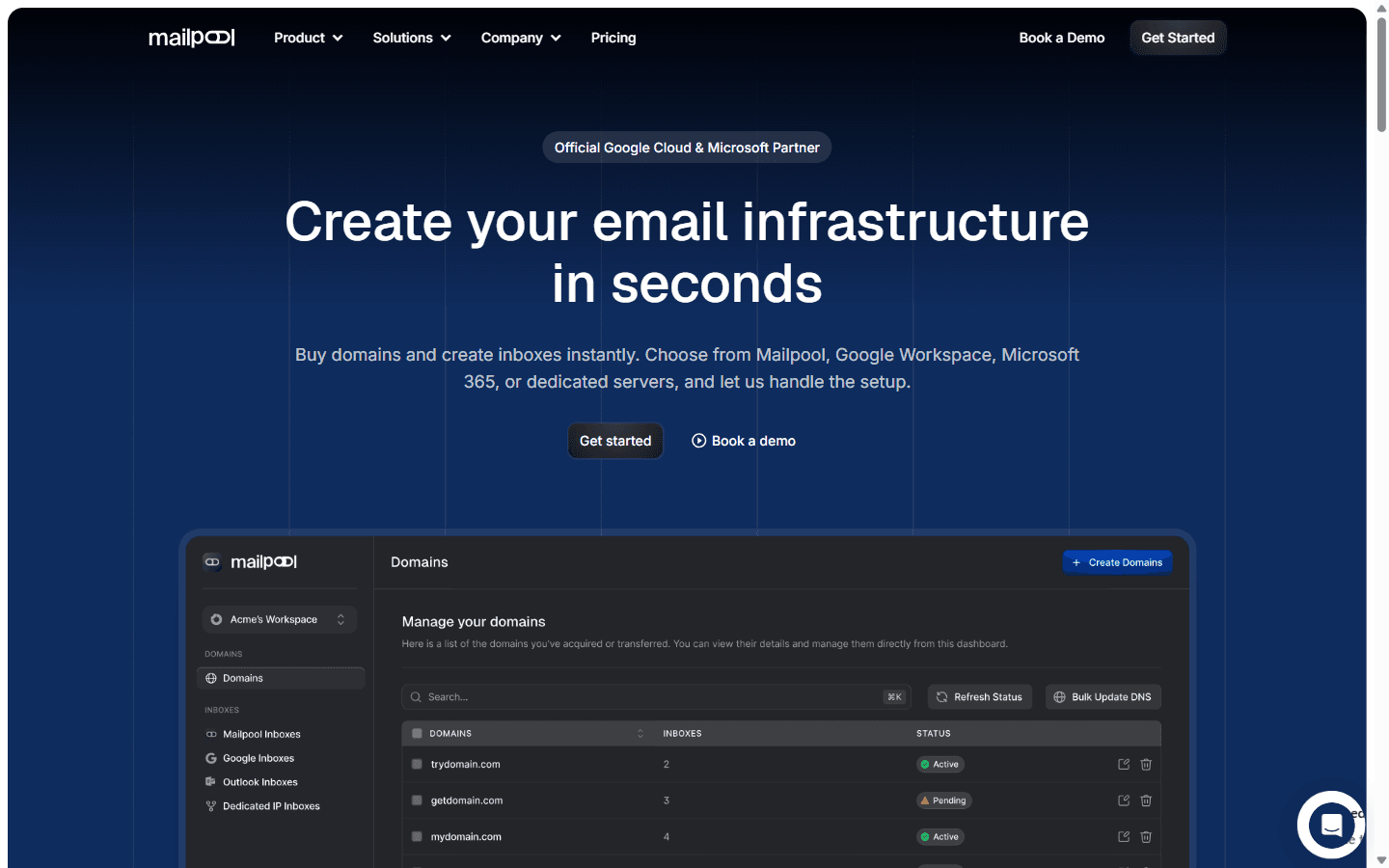
Per the provider, MailPool is "the ultimate email infrastructure platform" and an official Google Cloud and Microsoft Partner. The pitch is to automate the painful parts of email infrastructure, buying domains in bulk, creating inboxes across providers, and configuring deliverability, from one dashboard with no technical skill required.
The standout design choice is multi-provider inbox creation. Per the provider, buyers can spin up inboxes on:
That flexibility is unusual in this tier. Most providers are single-flavour (Google-only, Microsoft-only, or private-SMTP-only). MailPool lets buyers mix providers under one dashboard and rotate inboxes across them, which is genuinely useful for spreading deliverability risk and matching inbox type to audience.
The scale numbers (3,000+ companies and agencies, 35,000+ domains managed, 250,000+ inboxes created, and a stated ~5-minute setup time) lend the platform more credibility than is typical for this tier, and the GCP and Microsoft partner status, per the provider, gives it formal partnership coverage on the two underlying account types most buyers care about.
MailPool publishes a volume-based pricing model that varies by inbox provider rather than a single flat per-inbox rate. Figures and structure below were sourced from the MailPool homepage at the time of research.
| Factor | Detail (per provider) |
|---|---|
| Pricing model | Volume-based, varies by inbox provider |
| Inbox options | MailPool's own network, Google Workspace, Microsoft 365, dedicated servers / IPs |
| Setup time | ~5 minutes |
| Included | AI domain generator, automated SPF / DKIM / DMARC, domain and IP blacklist monitoring, unlimited inbox rotation, CSV export and native integrations |
A few notes on the pricing, based on the provider's pages:
The capabilities below are taken from the MailPool homepage at the time of writing. We did not independently verify each item in production.
The blacklist monitoring deserves a specific callout, it is one of the few providers in this tier that builds any monitoring into the platform, not just setup. The "AI" branding is lighter than the name suggests: per the provider, the meaningful AI feature is domain-name generation rather than deliverability decision-making.
MailPool's deliverability case rests on infrastructure breadth and bundled automation: automated SPF / DKIM / DMARC, multi-provider inbox creation, inbox rotation across providers, and ongoing domain and IP blacklist monitoring. The Google Cloud and Microsoft partner status, per the provider, is a real positive on the foundational platforms, and the scale numbers (3,000+ customers, 35,000+ domains, 250,000+ inboxes) imply a customer base large enough to expose any systemic deliverability problems.
Considerations buyers should weigh:
We did not run independent placement tests. The structural claims are consistent with credible multi-provider infrastructure platforms in the category; the performance claims are best evaluated against the buyer's own measured results.
The summary below reflects publicly advertised strengths and limitations relative to other providers in the same general category at the time of writing.
Pros
Cons
Based on the advertised feature set and pricing, MailPool may appeal to:
It may be a weaker fit for:
The table below summarises how MailPool compares to other providers in adjacent categories, based on publicly available information at the time of writing. Pricing and features change frequently; verify directly with each provider.
| Provider | Advertised model | Pricing | May suit |
|---|---|---|---|
| MailPool | Multi-provider inbox engine + blacklist monitoring | Volume-based | Provider flexibility and automation at scale |
| InboxKit | Plan-based, from $39 / mo for 10 mailboxes | Bundled mailbox + InfraGuard monitoring | Teams wanting mailboxes plus a deeper, real-time monitoring layer |
| Mailforge / Maildoso | Managed pools | ~$1.50 to $3 / mailbox | Cheap managed mailboxes |
| PrimeForge | Google / Microsoft self-serve | Per-mailbox | Mainstream Google / Microsoft with a dashboard |
| InfraBoxes | Private / Google + burn alerts | ~$2.50 to $3 / mailbox | Cheap mailboxes with monitoring bundled |
| InfraForge | Slot-based + dedicated IP | ~$2.50 to $4 + $99 / IP | High-volume teams in the Salesforge stack |
MailPool and InboxKit agree on a load-bearing point that most peers skip: monitoring belongs in the infrastructure platform, not as a separate purchase. The difference is depth and focus. Per the provider, MailPool optimises for multi-provider provisioning and rotation, with domain and IP blacklist monitoring as part of the package. InboxKit pairs warmed, isolated mailboxes with InfraGuard, a deeper monitoring layer spanning real-time blacklist alerts, DNS drift detection, and bounce-rate alerting. Buyers whose top priority is provider flexibility will lean MailPool; buyers whose top priority is continuous, multi-signal deliverability monitoring will lean toward the deeper monitoring stack. Disclosure: InboxKit is the publisher of this review.
Editorial rating: 7.5 / 10
Based on publicly available information, MailPool is one of the more mature and flexible infrastructure platforms in this tier. The multi-provider engine, spin up and rotate inboxes across Google Workspace, Microsoft 365, MailPool's own network, and dedicated servers from one no-code dashboard, is a genuine differentiator, and the platform is backed by real scale and a referenced Google Cloud and Microsoft partner status. The inclusion of domain and IP blacklist monitoring as a base feature is above the category baseline. For agencies and teams that value automation and provider diversity, it is a strong pick.
The rating is held below a higher score primarily by: (a) volume-based, provider-dependent pricing that makes side-by-side comparison harder; (b) "AI" branding that oversells the substance (the meaningful AI feature is domain generation, not deliverability AI); (c) blacklist monitoring that is useful but is not a full real-time deliverability stack; and (d) the absence of a public SOC 2 attestation on the homepage.
We did not independently test MailPool deliverability, suspension rates, or support response times. Buyers should treat this review as a structured summary of public information rather than a substitute for their own evaluation, and request a current quote for their specific provider mix and volume.
Readers comparing multi-provider inboxes with a deeper, real-time monitoring layer can see how InboxKit positions itself.
Per the MailPool homepage at the time of research, the platform uses volume-based pricing that varies by inbox provider (its own shared network, Google Workspace, Microsoft 365, or dedicated servers), rather than a single flat per-inbox rate. The practical monthly cost depends on the provider mix and volume; buyers should request a quote for their specific setup rather than assume a single per-inbox figure.
Per the provider, multi-provider inbox creation. MailPool lets a buyer spin up and rotate inboxes across MailPool's own network, Google Workspace, Microsoft 365, and dedicated servers from one no-code dashboard, instead of being locked into a single inbox type. That flexibility is unusual in this tier and is the headline differentiator.
Lightly. Per the provider, the meaningful AI feature is an AI domain-name generator that helps buyers generate and buy domains in bulk. Independent reviewers (for example PuzzleInbox) have specifically questioned whether the "AI" branding translates into measurable deliverability gains over standard setups; buyers should judge MailPool on automation and provider choice, not the AI label.
Per the provider, MailPool includes domain and IP blacklist monitoring plus automated SPF, DKIM, and DMARC. That is more monitoring than most providers in this tier offer, but it is not equivalent to a full real-time deliverability stack (DNS drift detection, bounce-rate alerts, burn alerts). Placement still depends on the buyer's sending practices and list quality.
Per the provider, MailPool is an official Google Cloud and Microsoft Partner, with publicly stated scale of 3,000+ customers, 35,000+ domains managed, and 250,000+ inboxes created. That is one of the more established footprints in this category, though the GCP and Microsoft references are partnership coverage on the underlying platforms rather than independent compliance attestations.
Free tools and pages that go with this guide.
From $2.50/mailbox/mo. No plans or slots. Automated DNS, warmup, and InfraGuard monitoring included.