
LearnComparisons
Pre-Warmed Mailboxes vs Self-Warmup: Which One Actually Wins in 2026?

By Mohit MimaniPublished on: Apr 11, 2026 · Updated: Oct 8, 2026 · 10 min read · Last reviewed: Oct 2026
TL;DR
Pre-warmed saves 14-21 days. Self-warmup gives full control and lower total cost on large batches. Here is the decision framework for picking, and the hybrid approach most operators actually run.
Pre-warmed mailboxes win when you need to ship cold outbound in the next 7 days and cannot wait for a 14-21 day warmup ramp. Self-warmup wins when you are provisioning 50+ mailboxes at a time, want full visibility into the sending history, or are rotating domains on a 60-90 day cycle where staged warmup fits the schedule.
Most operators running at scale do both. Pre-warmed accounts carry the first-wave sending while a bigger self-warmup batch seasons in the background, and the two pools rotate as domains age out. The rest of this article is the decision framework for choosing between them, and the numbers behind each side.
Pre-warmed mailboxes are real Google Workspace or Microsoft 365 accounts that the provider ran through 14-21 days of warmup traffic before you bought them. When you take delivery they already have sending history, folder placement measurements, and a reputation trend line. You connect a sequencer and start sending on day one.
Self-warmup is the same process but you run it yourself. You buy a fresh mailbox, attach it to a warmup network (isolated or shared pool), and wait 14-21 days while the system exchanges emails with other accounts at gradually increasing volume. When the ramp is complete you start real outbound.
Both approaches end in the same place, a mailbox with a warmup history and a reputation signal, but the calendar, the cost, and the quality control differ meaningfully. Read the email warmup guide for the full warmup mechanics; this article is the comparison, not the primer.
This is the most visible difference and usually the reason anyone considers pre-warmed at all.
| Stage | Self-Warmup | Pre-Warmed |
|---|---|---|
| Provisioning (domain + mailbox + DNS) | ~1 hour | ~1 hour |
| Warmup ramp | 14-21 days | Done before handoff |
| First real send | Day 15-22 | Day 1 |
| Hold-at-target volume | Day 21-28 | Day 7-10 |
Self-warmup on Google Workspace typically completes in 14-16 days. Microsoft 365 takes 17-21 days. Microsoft's spam filter is more conservative on new senders and needs more runway. If your campaign launches in two weeks, that math is viable. If the campaign launches on Monday and you are reading this on the previous Friday, self-warmup is not going to get there.
Pre-warmed collapses the timeline to zero at the cost of accepting someone else's warmup schedule. Provided the provider ran a disciplined warmup (see quality section below), the first-send reputation is comparable but slightly lower than a 21-day self-warm you ran yourself.
The old version of this comparison was easy: self-warmup was cheaper, pre-warmed was faster, you paid roughly 2-3x per mailbox for the speed. That math held for years because most providers gated pre-warming behind a separate premium tier.
As of April 2026, the pricing picture has shifted. Here is the current state:
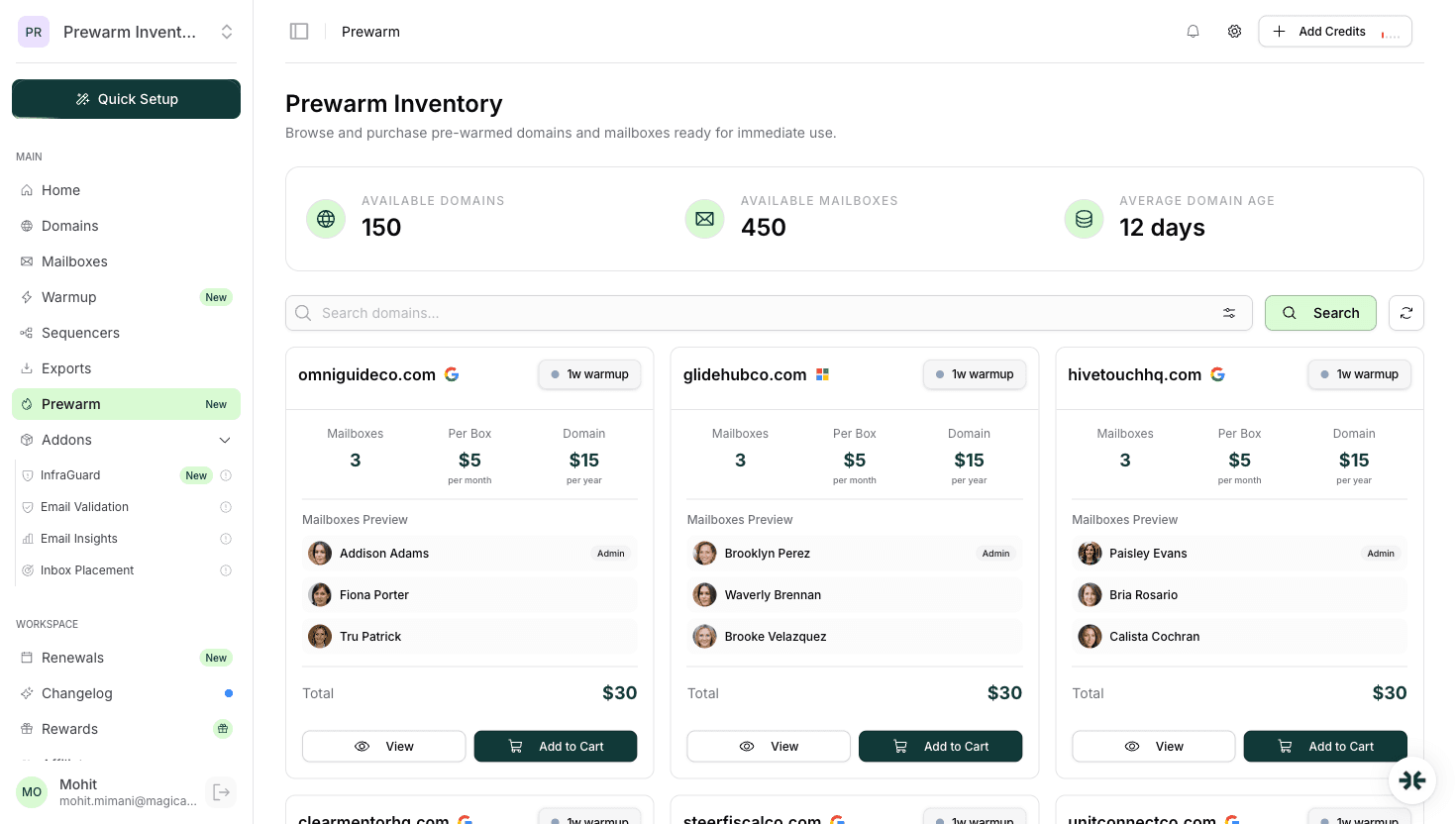
InboxKit offers a dedicated Prewarm Inventory section in the dashboard, a separate product area where you browse available pre-warmed domains and mailboxes and purchase them at per-mailbox pricing based on domain age:
| Domain warmup age | Per-mailbox price |
|---|---|
| 2-4 weeks warmup | $6/mailbox |
| 4-8 weeks warmup | $7/mailbox |
| 8+ weeks warmup | $9/mailbox |
Domain transfer costs apply on top (e.g. .com = $15). This is not a toggle or add-on within InboxKit's per-mailbox subscription. It is a distinct purchase flow for pre-warmed inventory.
Zapmail also offers pre-warmed mailboxes and claims 12 weeks of warmup. Zapmail's pre-warmed pricing is not publicly listed and requires a login to view, so we cannot publish a direct dollar comparison.
See the pricing teardown in InboxKit pricing for the full per-mailbox breakdown, and Zapmail pricing for Zapmail's side of the math.
Self-warmup gives you visibility into every warmup signal. You see the daily volume ramp, the folder placement on each warmup check, the reply rate from the seed network, and. If anything misbehaves. You can pause and investigate before the mailbox hits real outbound.
Pre-warmed hands you a finished product. You trust that the provider ran the warmup to spec. On a disciplined network that is a safe bet; on a shared pool it is a gamble that you cannot audit retroactively.
For operators who care about the audit trail (regulated verticals, agencies writing deliverability SLAs into client contracts, or teams running sensitive campaigns where reputation damage is expensive), self-warmup wins this axis regardless of cost. For everyone else, the transparency gap is a theoretical concern that does not show up in real outcomes as long as the underlying network is clean.
Below 30 mailboxes, pre-warming is often the right call even when time is not the deciding factor, the per-mailbox premium on a small batch is small in absolute dollars and the time savings compound with every week you are delayed on launch.
Above 50 mailboxes, self-warmup starts winning on total cost and scheduling flexibility. At scale, self-warming on standard InboxKit mailboxes provides the same deliverability as a pre-warmed batch at a lower per-mailbox cost, with the added benefit of a staged ramp where you can turn mailboxes on gradually rather than all at once.
| Batch size | Recommended approach | Why |
|---|---|---|
| 5-10 mailboxes | Pre-warmed | Small absolute premium, time savings dominate |
| 10-30 mailboxes | Pre-warmed or hybrid | Judgment call on launch date |
| 30-50 mailboxes | Hybrid: pre-warmed for first wave, self-warmup for reserves | Best of both |
| 50+ mailboxes | Self-warmup (or hybrid with small pre-warmed) | Economics flip; staged ramp easier to manage |
Reading r/coldemail and talking to email agencies at any scale reveals that the pure pre-warmed vs pure self-warmup debate is a false choice. Operators running sustained cold outbound almost always do both:
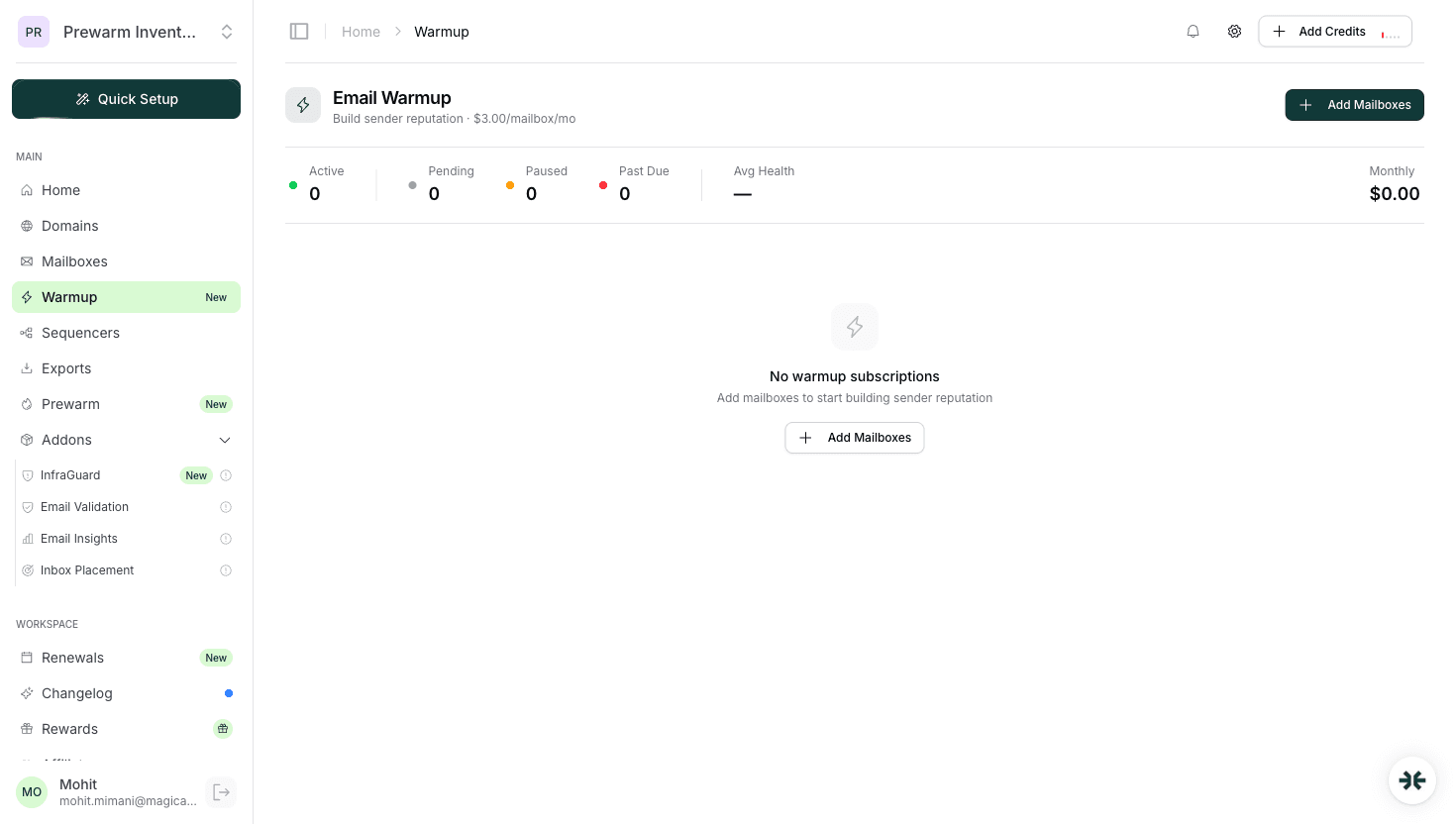
This workflow treats pre-warmed as a short-term accelerator and self-warmup as the steady-state engine. InboxKit supports both modes from the same dashboard, see the email infrastructure setup guide for the full provisioning workflow.
Use this checklist to decide for a specific campaign, not for every campaign you will ever run:
Choose pre-warmed if any of these are true:
Choose self-warmup if any of these are true:
Choose hybrid if:
The worst answer is picking neither and rushing a bare mailbox into cold sending with no warmup at all. That is how domains get burned in 48 hours, and it is the mistake the original version of this question, 'how do I skip warmup', usually leads to.
Pre-warmed mailboxes are worth their premium when time is genuinely the constraint and you are buying from a provider running a disciplined isolated warmup network. They are not worth the premium when the campaign can wait two weeks or when the provider is dressing up shared-pool warmup as a premium tier.
Self-warmup is the steady-state answer for sustained email programs. It costs less per mailbox, gives you full visibility, and scales better above 50 mailboxes. The 14-21 day wait is only a problem if you do not have it.
The practical answer for most operators at any scale is to run both in rotation, pre-warmed for immediate capacity, self-warmup for the bench, and a continuous cycle of domains moving through the warmup ramp. If you want that workflow on one dashboard, read InboxKit pre-warmed mailboxes for the current prewarm offering and are pre-warmed mailboxes worth it for the honest prior-year analysis.
Yes on the calendar, pre-warmed gives you day-one send capability while self-warmup takes 14-21 days. But faster doesn't always mean better: a pre-warmed mailbox on a shared warmup pool can underperform a self-warmed mailbox on an isolated network. Speed matters for the launch date; quality matters for the whole program.
In April 2026 the gap has narrowed compared to prior years. InboxKit offers pre-warmed mailboxes through a dedicated Prewarm Inventory section at $6-9/mailbox depending on domain warmup age, plus domain transfer costs. Zapmail also offers pre-warmed mailboxes (claiming 12 weeks of warmup) but does not publicly list pre-warmed pricing. Both providers price pre-warmed above their standard subscription rates, but the exact multiplier depends on the provider and warmup duration.
Yes, and it is the workflow most experienced email operators actually use. Pre-warmed covers the first wave of sending while a self-warmup bench seasons in parallel. The two pools rotate as domains age. Both live in the same InboxKit dashboard with unified monitoring.
Very small if the network is isolated. The gap shows up in the first 7-10 days of real sending, where self-warmed mailboxes on their own historical ramp tend to stay in primary inbox 2-4 percentage points more than pre-warmed. After two weeks of real sending the gap closes because recipient engagement dominates the reputation signal.
No. Sending cold outbound from a mailbox with zero warmup history is how domains get burned in 24-48 hours. If you cannot wait for self-warmup, buy pre-warmed. If you cannot afford pre-warmed, wait for self-warmup. Never send from a bare mailbox. Read skip-email-warmup-safely for the longer answer.
No. Pre-warming handles the initial 14-21 day ramp. Ongoing warmup traffic (typically 20-40 emails per mailbox per day on top of real sending) keeps the reputation signal fresh when you scale or rotate send volume. InboxKit's isolated warmup network keeps running in the background after handoff.
Free tools and pages that go with this guide.
 Guides
 Mohit MimaniEducational
 Rahul LakhaneyGuidesRahul LakhaneyGuidesRahul Lakhaney
From $2.50/mailbox/mo. No plans or slots. Automated DNS, warmup, and InfraGuard monitoring included.