
LearnReviews
Woodpecker Review 2026

By Saksham JainPublished on: May 26, 2026 · Updated: Sep 6, 2026 · 11 min read · Last reviewed: Sep 2026
TL;DR
Woodpecker positions itself as one of the more deliverability-conscious mid-market email tools, and on paper the headline facts back that up at the time of writing: adaptive sending that Woodpecker describes as human-like pacing, free unlimited email accounts and team members on its base subscription, free warm-up (limited to 2), and an EU-based, GDPR-aware posture (the company is based in Poland). For agencies and teams that prioritise careful sending over volume, it is a defensible pick. The honest catch is the usage-based pricing, which is billed per contacted prospect and can get confusing or expensive at scale, and the fact that, like every sequencer, deliverability still depends on the mailboxes and domains you connect.
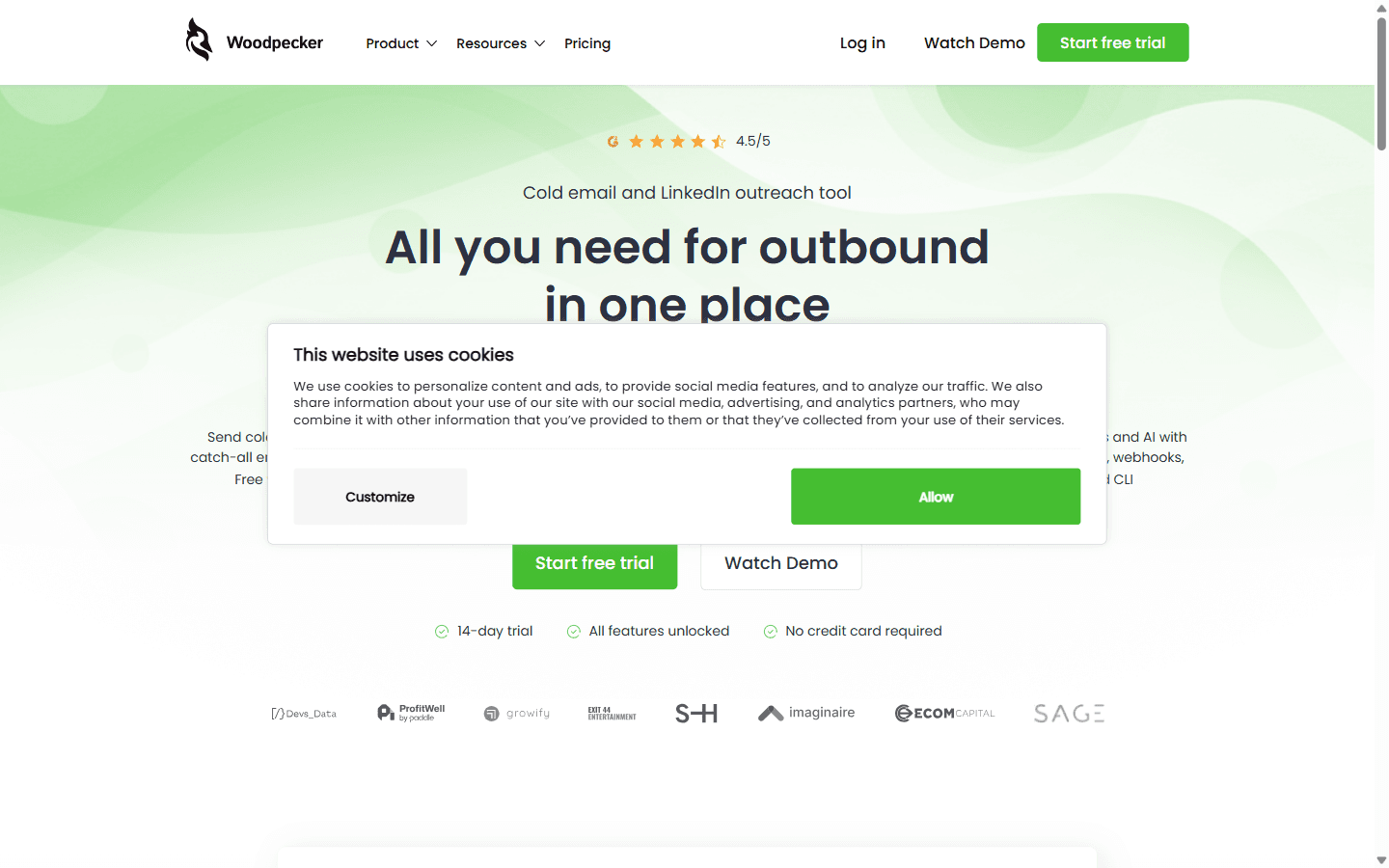
Woodpecker (woodpecker.co) is an email and LinkedIn outreach platform headquartered in Wrocław, Poland. Woodpecker states it is used by 13,000+ professionals (figure self-reported by the provider). Its identity is deliverability and compliance: adaptive sending, inbox rotation, condition-based campaigns, and a GDPR-aware EU data stance.
The pricing model is unusual. Instead of charging per mailbox or per seat, Woodpecker charges by contacted prospects, with unlimited email accounts and unlimited team members included on its base subscription per the published pricing page. Free warm-up (limited to 2), free catch-all email verification, and 400 monthly Lead Finder credits are also listed as included. You scale by paying for how many people you reach, not how many inboxes you run.
Woodpecker is usage-based, billed on contacted prospects, with annual billing advertised as saving up to 33%. Pricing observed on woodpecker.co/pricing at the time of writing and is subject to change.
| Element | Cost | Notes |
|---|---|---|
| Entry point | $35/mo monthly ($24/mo annual) | 6,000 emails, 2,000 stored prospects, 500 contacted |
| Contacted prospects | $5 per 100 (Woodpecker advertises down to ~$0.01 per 100 at top scale) | The main scaling lever |
| Email accounts | Advertised as free, unlimited | No per-mailbox fee on the base plan |
| Team members | Advertised as free, unlimited | No per-seat fee on the base plan |
| Warm-up | 2 free, then $5/mo each | Powered by Mailivery per Woodpecker docs |
| Catch-all email verification | Free, unlimited | Bouncer integration per Woodpecker docs |
Honest notes on the real cost:
Woodpecker's defaults appear conservative compared with several mid-market sequencers. Adaptive sending throttles volume, the deliverability monitor flags issues, and the agency panel advertises automated audits on client domains. If deliverability discipline is your priority, Woodpecker's defaults are a reasonable starting point.
The core truth still applies, though: placement is largely decided by your infrastructure. Adaptive sending and rotation help, yet the domains, authentication, and mailbox health you connect tend to dominate inbox placement. And while Woodpecker monitors sending behaviour and surfaces some domain checks, we could not find infrastructure-wide real-time alerting on blacklisting and DNS drift across an entire domain stack in the published product. Its in-platform mailbox options are also a marketplace layer, with less control than buying infrastructure directly.
The summary below reflects publicly advertised strengths and limitations relative to other email sequencers at the time of writing.
Pros
Cons
Good fit:
Bad fit:
| Option | What it is | Strength | Best for |
|---|---|---|---|
| Woodpecker | Email sequencer | Deliverability-first, free inboxes | Careful, compliant senders |
| Smartlead | Email sequencer | Unlimited accounts, agency tooling | High volume, agencies |
| Saleshandy | Email sequencer | Value pricing | Budget-conscious senders |
| InboxKit | Mailbox infrastructure + InfraGuard | Mailboxes + real-time monitoring | The infrastructure layer under any sequencer |
The honest positioning: Woodpecker is a sequencer, and InboxKit is not a competitor, it is the layer underneath. Woodpecker offers in-platform mailboxes, but that is a marketplace; InboxKit provides isolated, controllable mailboxes directly, plus InfraGuard monitoring (real-time blacklist alerts, DNS drift detection, bounce-rate alerting) across your full domain stack. Because InboxKit is sequencer-agnostic, those mailboxes run in Woodpecker today and any other tool tomorrow.
Rating: 8 / 10
Woodpecker reads as the careful operator's email tool: adaptive sending, unlimited inboxes and team members on the base subscription, free warm-up (2) and verification, and a compliance and agency posture that is among the more thorough in the category at the time of writing. If you value careful, deliverable sending over raw volume, it is a defensible choice.
It isn't higher because the usage-based pricing can get confusing and expensive at scale, several capabilities are paid add-ons, and, like every sequencer, deliverability depends on the infrastructure you connect; we could not find infrastructure-wide monitoring of blacklists and DNS drift in the published product.
If you want isolated, monitored mailboxes feeding Woodpecker, while staying free to switch sequencers later, see how InboxKit compares.
Per woodpecker.co/pricing: usage-based starting at $35/mo monthly or $24/mo on annual billing (6,000 emails, 2,000 stored prospects, 500 contacted), then $5 per 100 contacted prospects, dropping toward $0.01 per 100 at very high volume. Unlimited email accounts and team members are free.
Yes. 2 warm-ups are free (powered by Mailivery); additional warm-ups are $5/month each.
Yes, it's one of the more deliverability-conscious sequencers, thanks to adaptive sending, inbox rotation, and a deliverability monitor.
It offers in-platform Google or Microsoft mailboxes at $6/email/mo and Maildoso or Mailforge mailboxes at $4/email/mo, but that's a marketplace layer rather than direct infrastructure.
It monitors sending behavior and audits client domains in the agency panel, but it is not infrastructure-wide real-time monitoring. For that, use a layer like InboxKit's InfraGuard.
Free tools and pages that go with this guide.
 Reviews
 Saksham JainReviewsSaksham JainReviewsSaksham JainReviewsSaksham JainReviews
 Mohit Mimani
From $2.50/mailbox/mo. No plans or slots. Automated DNS, warmup, and InfraGuard monitoring included.