
On this page

 vs
vsInboxKit vs AgentMail: Email Infrastructure vs Agent Inbox API (2026)
If you're comparing InboxKit and AgentMail, the most useful thing to know up front is that, in our view, they aren't really competitors — they solve different problems that happen to both involve email and inboxes. InboxKit is email infrastructure: real Google, Microsoft, and Azure mailboxes (with Isolated Warmup and InfraGuard available as add-ons per the InboxKit pricing page) built to run outbound campaigns. AgentMail is an email inbox API for AI agents: programmatic, two-way inboxes that let software agents send, receive, and react to mail in real time. This page exists to help readers avoid buying the wrong category.
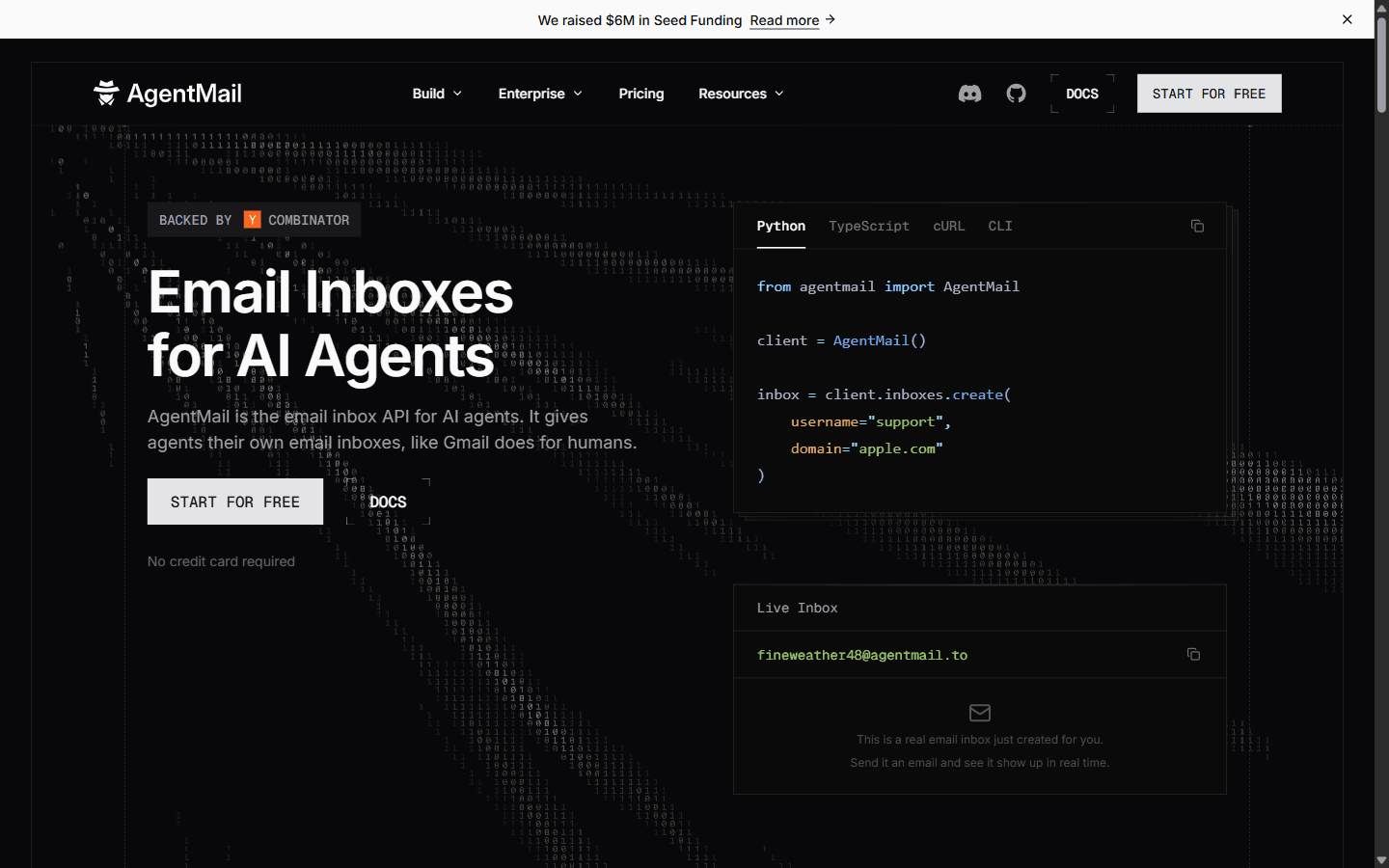
AgentMail homepage as of May 2026
Our Summary
AgentMail (agentmail.to) describes itself as "the email inbox API for AI agents, like Gmail does for humans." Per the AgentMail blog and TechCrunch coverage, it's a Y Combinator (Summer 2025 batch) company that raised a $6M seed round led by General Catalyst (announced March 10, 2026), with participation from Y Combinator, Phosphor Capital, and angel investors including Paul Graham, Dharmesh Shah (HubSpot CTO), Paul Copplestone (Supabase CEO), and Karim Atiyeh (Ramp CTO). It's an API-first product that lets developers spin up real inboxes programmatically and give each AI agent its own email identity — send, receive, thread, reply, parse attachments, and react to inbound mail in real time over webhooks and websockets. It ships SDKs and a native MCP server so agents (and tools that speak MCP) can manage email directly.
AgentMail handles deliverability basics — automated DKIM/SPF/DMARC, suppression lists, optimized shared IPs, with dedicated IPs available by request on higher tiers — but, per the provider, that's transactional / agent deliverability, not cold-outreach reputation management. AgentMail is not marketed with a cold-tuned warmup engine, a per-domain isolation strategy for outbound, or burn-style deliverability alerting. Pricing is published and usage-based at the publication date: Free ($0, 3 inboxes, 3,000 emails/month, 100/day cap), Developer ($20/month, 10 inboxes, 10,000 emails), Startup ($200/month, 150 inboxes, 150,000 emails, SOC 2 report per the provider, Slack support, dedicated IPs on request), and a custom Enterprise tier (white-label, EU region, BYO cloud, OIDC/SAML SSO). Per the TechCrunch interview with co-founder Haakam Aujla, AgentMail has "500+ B2B customers" alongside larger user metrics — we treat the number as provider-reported.
Feature Comparison
| Feature |  InboxKit InboxKit | |
|---|---|---|
| Category & User | ||
| Category | Email infrastructure | Email API for AI agents |
| Primary User | Cold outreach teams, agencies | Developers building AI agents |
| Interface | Dashboard + sequencer integrations | API, SDKs, MCP server |
| Mailbox & Reputation | ||
| Mailboxes | Real Google / Microsoft / Azure on dedicated US IPs (per InboxKit) | Programmatic inboxes — optimized shared IPs, dedicated by request (per the provider) |
| Warmup | Isolated Warmup add-on (+$3/mailbox per InboxKit pricing page) | Not marketed as cold-tuned |
| Domain Isolation | Described by InboxKit as a design goal | Not advertised as a primary focus |
| Monitoring & Deliverability | ||
| Monitoring | InfraGuard add-on, first month free (per InboxKit pricing page) | Per the provider: metrics, signed webhooks |
| Authentication | Automated SPF/DKIM/DMARC (per InboxKit) | Automated SPF/DKIM/DMARC (per the provider) |
| Pricing | ||
| Entry Price | $2.50/mailbox/mo | Free tier; $20/mo Developer |
| Mid Volume | 30 × $2.50 = $75/mo (annual) | $200/mo Startup (150 inboxes, 150K emails) |
| High Volume | 100 × $2.50 = $250/mo (annual) | Custom (white-label, EU, BYO cloud, SSO) per the provider |
| Governance & Developer | ||
| API & Webhooks | REST + webhooks (per InboxKit website) | API + SDKs + native MCP server (per the provider) |
| SOC 2 | — | Report from Startup tier (per the provider, not independently verified) |
| SSO | — | OIDC/SAML on Enterprise (per the provider) |
Switch to InboxKit
Dedicated IPs. Isolated infrastructure. From $2.50/mo.
Pricing Comparison
InboxKit
inboxkit.com
- Google WorkspaceFrom $2.50/mailbox/mo
Real US-IP Google accounts, full admin access. One rate per mailbox, from $2.50/mo on annual billing ($2.70 quarterly, $3.00 monthly). No plans, no slots, no base fee.
- Microsoft 365From $2.50/mailbox/mo
Official Microsoft 365 accounts with admin control. Same flat rate as Google Workspace, no Microsoft premium.
- Azure Mailboxes$30/tenant/mo
Up to 100 mailboxes per tenant on Azure infrastructure. Same price on every cycle.
 AgentMail
agentmail.to
- Free$0
3 inboxes, 3,000 emails/month (100/day cap), shared IPs
- Developer$20/mo
10 inboxes, 10,000 emails/month, 10 custom domains, no daily cap
- Startup$200/mo
150 inboxes, 150,000 emails/month, SOC 2 report, Slack support, dedicated IPs on request
- EnterpriseCustom
White-label, EU region, bring-your-own cloud, OIDC/SAML SSO
Pricing Verdict: Comparing the prices directly is misleading because you're buying different things. AgentMail meters API inboxes and email volume for agents (free, then $20/$200/custom). InboxKit prices warmed, monitored campaign mailboxes from $2.50/mailbox/mo ($3.00 monthly), so on annual billing 10 × $2.50 = $25/mo, 30 × $2.50 = $75/mo and 100 × $2.50 = $250/mo. Pick by category, not by the dollar figure.
Infrastructure and Deliverability
Designed for Outbound Reputation
Email is adversarial: high volume to people who didn't ask, with filters looking for reasons to flag you. Surviving that generally requires isolated sending domains, warmup ramped for cold volume, and real-time monitoring. InboxKit positions its design around those requirements. AgentMail is not marketed for that workload — its category is two-way agent email.
InfraGuard Add-On with Auto-Pause
Per the InboxKit pricing page, InfraGuard is offered as an add-on with the first month free, then as a paid add-on. Per the provider, the feature set includes blacklist checks every 6 hours, DNS drift detection, bounce tracking, and automatic mailbox pausing when metrics go red. AgentMail's deliverability tooling, per the provider, is transactional / agentic — DKIM/SPF/DMARC, suppression, metrics, signed webhooks.
Dashboard + Sequencer Integrations
Per the InboxKit website, 24+ native platform integrations (Instantly, Smartlead, Lemlist, Reply.io, Salesforge, Woodpecker, and more). A campaign operator can run InboxKit without writing code; AgentMail is API / SDK / MCP-first and assumes a developer is wiring it up.
Real Provider Accounts vs API Inboxes
Per InboxKit, mailboxes are real Google Workspace, Microsoft 365, and Azure accounts. Per AgentMail, the product provisions programmatic inboxes on optimized shared IPs (with dedicated IPs on request). The two architectures are tuned for different jobs; we did not benchmark deliverability between them.
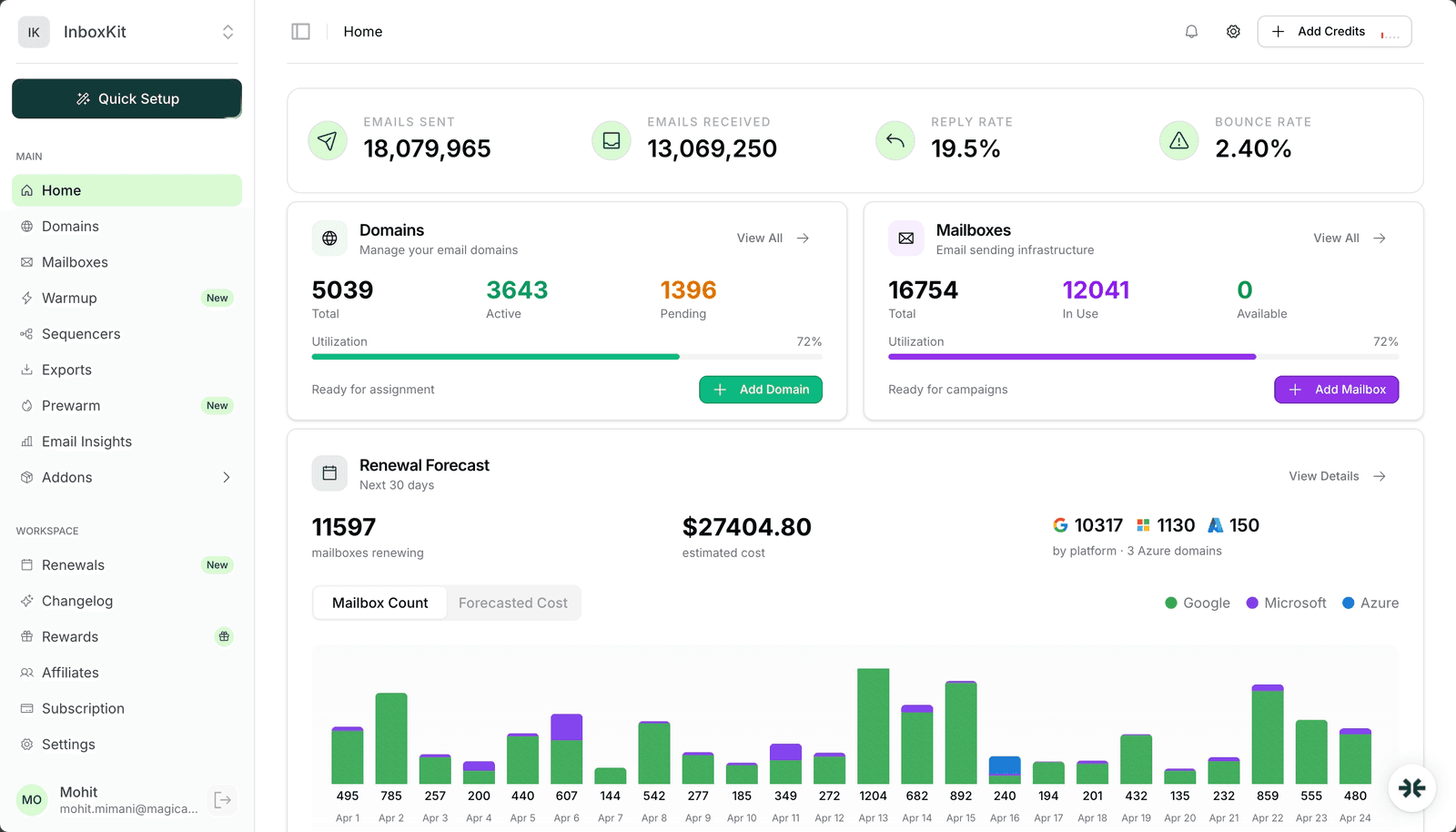
InboxKit dashboard — 18M+ emails, 5,039 domains, 16,754 mailboxes for a single client
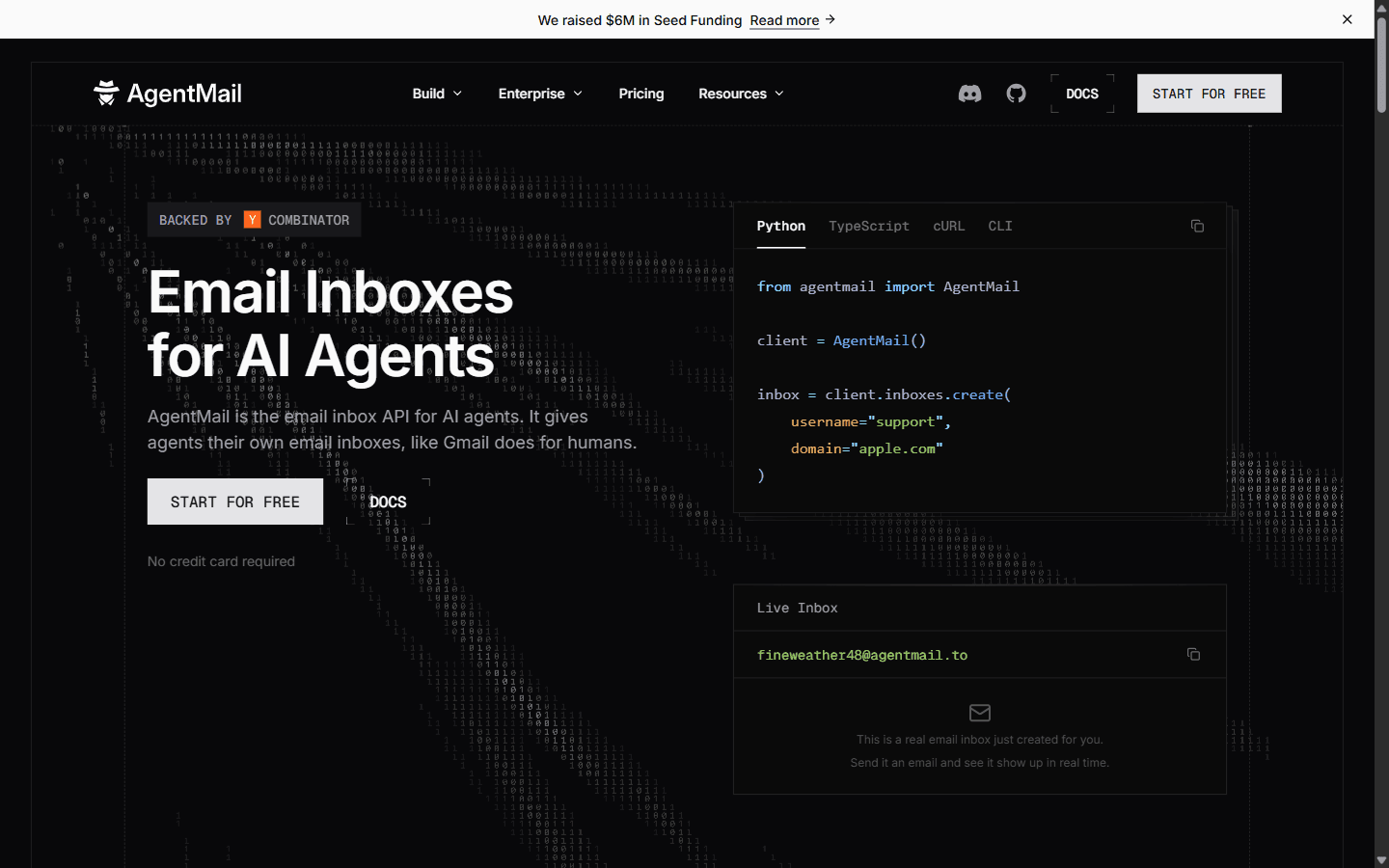
AgentMail homepage
Pros & Cons
InboxKitStrengths
- Designed for outbound: real Google / Microsoft / Azure accounts on dedicated US IPs (per InboxKit)
- Isolated Warmup add-on (+$3/mailbox per InboxKit pricing page) and InfraGuard monitoring add-on with first month free
- Dashboard + 24+ native sequencer integrations (per InboxKit) for non-developer operators
- Agency workspace isolation for managing client fleets (per InboxKit)
Limitations
- Not an API-first product for AI agents (different category)
- Higher entry price than AgentMail's free tier (from $2.50/mailbox/mo vs $0)
- No native MCP server advertised for agent use cases
Strengths
- Purpose-built for AI agents: API, SDKs, native MCP server, real-time inbound via webhooks/websockets (per the provider)
- Genuinely free tier (3 inboxes, 3,000 emails/month, no card required)
- Transparent usage-based pricing across tiers
- $6M seed led by General Catalyst (March 2026 per TechCrunch); Y Combinator Summer 2025 batch
- SOC 2 report from Startup tier, OIDC/SAML SSO on Enterprise (per the provider)
Limitations
- Not email infrastructure — not marketed with cold-tuned warmup or domain-isolation strategy
- Deliverability tooling appears transactional / agentic, not cold-outreach burn alerting
- Developer-only — no campaign dashboard
- Dedicated IPs by request, not self-serve, even on Startup tier (per the provider)
- Young company in a young category
Who Should Choose What
In our view, InboxKit and AgentMail solve different problems. If you're building infrastructure to run email campaigns, InboxKit appears to be the category-appropriate choice — real Google/Microsoft/Azure mailboxes with optional Isolated Warmup and InfraGuard add-ons. If you're a developer giving an AI agent its own email identity, AgentMail is purpose-built and credibly funded ($6M seed led by General Catalyst, YC S25). The mistake to avoid is buying AgentMail for cold outreach.
Got questions? We've got answers.
Per the provider, no. AgentMail is positioned as an email API for AI agents — two-way, transactional / agentic email. It is not marketed with cold-tuned warmup, a per-domain isolation strategy for outbound, or burn-style deliverability monitoring. For cold campaigns, email-specific infrastructure (such as InboxKit) is the category-appropriate option.
We do not recommend it. AgentMail is not marketed for cold outreach, and the typical cold-outreach requirements (isolated sending domains, cold-tuned warmup, burn monitoring) are not part of its advertised feature set. Cold volume on a product not designed for it can risk inbox placement and domain reputation.
No. Per the InboxKit website, InboxKit provides real Google Workspace, Microsoft 365, and Azure mailboxes for cold outreach, with Isolated Warmup and InfraGuard available as add-ons (first month free for InfraGuard per the InboxKit pricing page). If you need programmatic, per-agent inboxes for an AI agent, AgentMail is purpose-built for that workload.
They price different products. AgentMail meters agent inboxes and email volume (Free, $20 Developer, $200 Startup, custom Enterprise per the provider's pricing page). InboxKit prices mailbox infrastructure (from $2.50/mailbox/mo, so 10 mailboxes is 10 × $2.50 = $25/mo on annual billing, per the InboxKit pricing page). A like-for-like comparison should account for any add-ons you opt into on either side.
Per both providers, yes — both automate SPF/DKIM/DMARC. The difference is what's built on top: per InboxKit, an Isolated Warmup add-on and an InfraGuard monitoring add-on; per AgentMail, agent identity, real-time inbound (webhooks and websockets), and developer tooling (SDKs, MCP server, signed webhooks).
Keep Reading
Competitor pricing and feature details were verified in June 2026. Pricing changes often — always confirm current rates on the provider's official website.
Ready to try InboxKit?
Dedicated US IPs. Isolated infrastructure. Real Google & Microsoft accounts from $2.50/mo.