
LearnReviews
AgentMail Review 2026

By Saksham JainPublished on: May 20, 2026 · Updated: Sep 6, 2026 · 10 min read · Last reviewed: Sep 2026
TL;DR
AgentMail is an email inbox API for AI agents: it lets developers create programmatic inboxes so software agents can send, receive, and act on email in real time. It is API-first and well-funded, but it is a different category from email infrastructure. This review summarizes what AgentMail is, its published usage-based pricing, what we could and could not independently verify, and why teams shopping for cold-outreach mailboxes should weigh the category difference before evaluating it.
This review is based on publicly available information as of the publication date, including the AgentMail website (agentmail.to), its pricing page, its documentation, and its funding-announcement blog post, plus secondary coverage from TechCrunch, a GlobeNewswire release, Y Combinator's company page, Product Hunt, and the Hacker News launch thread. We did not independently build on the API, did not provision inboxes, did not measure deliverability, and did not audit support. Where we describe features, pricing, or behavior, the source is the provider's own materials or the cited third-party source unless otherwise stated.
A scope note: AgentMail is not an email outreach product, and it is not marketed as one. Because this site covers email infrastructure, this review assesses AgentMail on its own merits as an agent email API and then explains, in plain terms, why it is a different category from the mailbox providers emailers usually compare. The editorial rating reflects AgentMail as an agent email API, not as a cold-outreach mailbox provider.
InboxKit, the publisher of this review, sells email deliverability tooling. AgentMail is not a direct competitor in that category; we reference InboxKit only where an email reader needs a category-appropriate pointer.
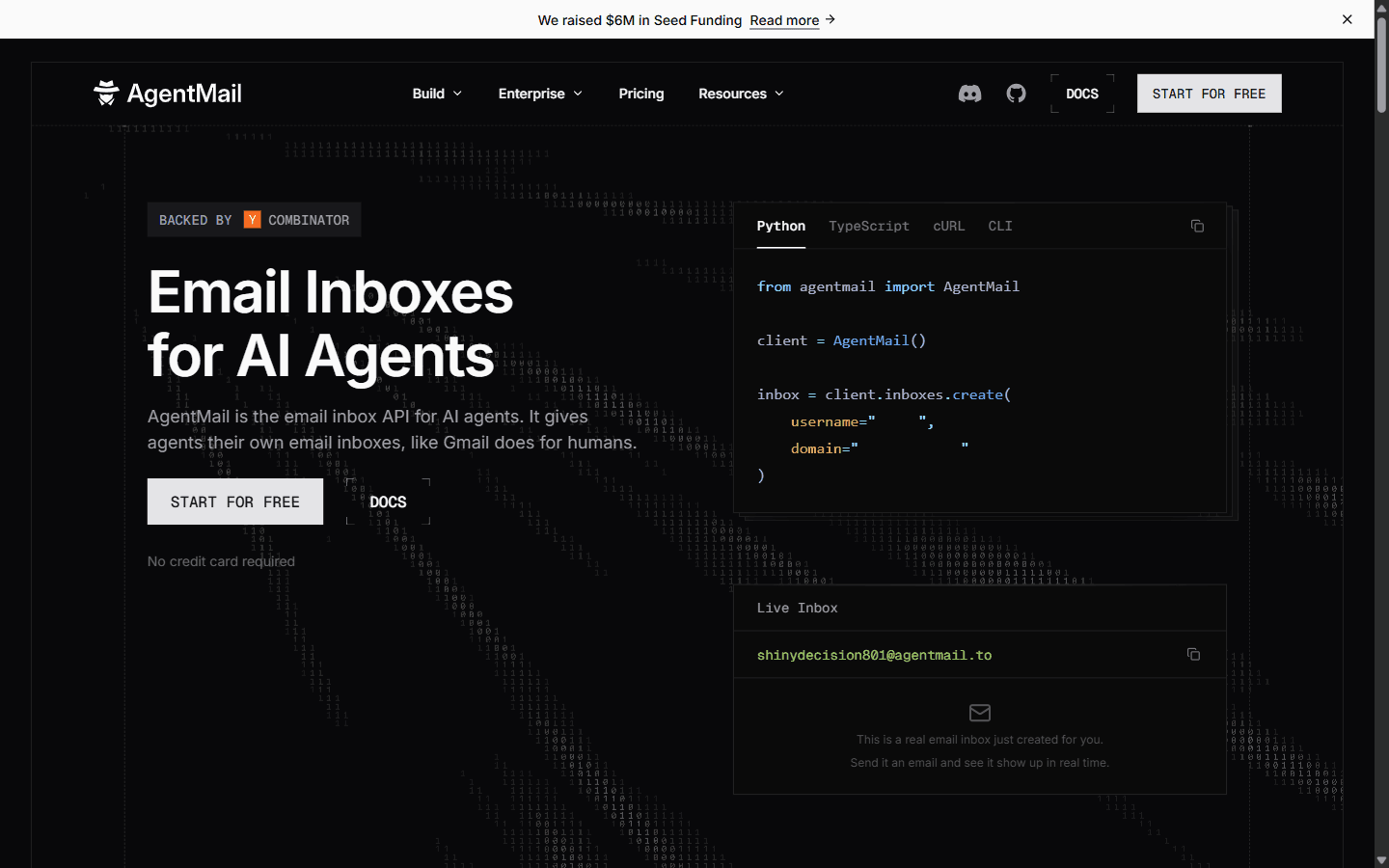
AgentMail positions itself as "the email inbox API for AI agents." Per the provider, it lets developers create real inboxes programmatically and give each AI agent its own email identity, so the agent can send, receive, thread, reply, parse attachments, and react to incoming mail in real time. The product is API-first and built for code rather than for a campaign dashboard.
Key capabilities described in the provider's materials:
AgentMail describes itself as founded in 2025 and a Y Combinator company (Summer 2025 batch); its public founders are Haakam Aujla, Michael Kim, and Adi Singh. The provider reports traction figures including tens of thousands of human users, hundreds of thousands of agent accounts, and 500+ business customers; we did not independently verify these and treat them as provider claims.
The single most important thing for an email reader to understand: AgentMail solves "my AI agent needs to handle email." It is not built or marketed to solve "I need a fleet of warmed, isolated mailboxes to run cold outreach without landing in spam." Those are different categories.
AgentMail publishes usage-based pricing that scales with inboxes and email volume. The figures below were confirmed on the provider's pricing page at the time of research.
| Plan | Price / month | Inboxes | Emails / month | Notable inclusions (per provider) |
|---|---|---|---|---|
| Free | $0 | 3 | 3,000 (100 / day cap) | Threads, labels, drafts, SDKs, MCP server, shared IPs, 2 webhook endpoints, Discord support |
| Developer | $20 | 10 | 10,000 (no daily cap) | 10 custom domains, email support |
| Startup | $200 | 150 | 150,000 | 150 custom domains, 10 webhook endpoints, SOC 2 report, Slack support; dedicated IPs by request |
| Enterprise | Custom | Custom | Custom | White-label, EU region, bring-your-own cloud, OIDC/SAML SSO, usage-based pricing, bulk discounts |
A few notes on the pricing:
The capabilities below are taken from AgentMail's pricing page and documentation at the time of writing. We did not independently verify each item in production.
These are the features a developer wants when wiring email into an agent: clean APIs, real-time inbound, identity, and governance. AgentMail's documentation does include guidance on domain management and rotation in a deliverability-at-scale context, so it is not accurate to say it ignores domains entirely. What it is not built around, and does not market, is the cold-outreach toolkit: a warmup engine tuned for cold sending ramps, per-domain isolation strategy for outbound reputation, and burn-style deliverability alerting designed to survive aggressive cold volume.
This is the comparison most email readers actually need: is AgentMail a substitute for an email mailbox provider? Based on its own positioning, no, it is a different category.
| Dimension | AgentMail (per provider) | Email infrastructure (category) |
|---|---|---|
| Primary user | Developers building AI agents | Cold outreach teams and agencies |
| Interface | API, SDKs, MCP server | Dashboard plus sequencer integration |
| Email pattern | Two-way, agentic / transactional | High-volume one-way outbound |
| Warmup | Not marketed as cold-tuned warmup | Core feature, ramped for cold sending |
| Reputation model | Shared IPs (dedicated by request) | Engineered for cold-volume reputation |
| Deliverability tooling | Deliverability basics plus metrics | Blacklist, DNS-drift, and bounce-rate monitoring |
If you are building an AI agent that needs real, two-way email, AgentMail is purpose-built and well-funded for that job. If you are running email, you want infrastructure designed for outbound reputation: warmed, isolated sending domains and real-time deliverability monitoring, which is the category InboxKit operates in (mailboxes bundled with InfraGuard monitoring: blacklist alerts, DNS drift detection, and bounce-rate alerting). Disclosure: InboxKit is the publisher of this review.
The summary below reflects AgentMail's publicly advertised strengths and limitations as an agent email API. It is not a judgment of AgentMail as a cold-outreach product, because the provider does not market it as one.
Pros
Cons
Based on the advertised feature set, AgentMail may appeal to:
It is a weak fit, by design, for most email buyers:
If you arrived here while shopping for email infrastructure, AgentMail is the wrong category, and the realistic alternatives are mailbox providers built for outbound reputation. The table below is oriented to that email reader, based on publicly available information; verify current pricing and features directly with each provider.
| Option | Category | Best for |
|---|---|---|
| AgentMail | Email API for AI agents | Developers wiring email into AI agents |
| InboxKit | Email mailboxes plus monitoring | Teams wanting warmed mailboxes plus bundled InfraGuard monitoring |
| InfraForge | Private, dedicated-IP infrastructure | High-volume teams in the Salesforge stack |
| AeroSend | Isolated private infrastructure plus burn alerts | Agencies wanting managed isolation plus monitoring |
| Premium Inboxes | Managed Google / Microsoft mailboxes | Teams wanting a high-touch done-for-you setup |
For an email operation, the relevant requirements are warmed, isolated sending domains and real-time deliverability monitoring, none of which is AgentMail's purpose. An email-specific provider (such as InboxKit, which bundles mailboxes with InfraGuard monitoring) is the category-appropriate place to look. Disclosure: InboxKit is the publisher of this review.
Editorial rating: 8 / 10 (as an agent email API; not applicable to email)
As an email inbox API for AI agents, AgentMail is a strong, credible product. For developers building agents that need real, two-way email with real-time inbound, identity, and governance, it is purpose-built, well-documented, transparently priced, and credibly funded (a $6M seed led by General Catalyst, and a Y Combinator company). Within the agent-email niche, it is one of the cleaner options we reviewed.
The rating carries a hard category caveat: AgentMail is not email infrastructure and is not marketed as such, so it should not be evaluated as a mailbox provider for outreach. The score reflects AgentMail as an agent email API, not as a cold-outreach tool. Public reception is mixed in places (Product Hunt is positive; the Hacker News launch was lively but divided), and the company and category are both young.
We did not independently build on the API, provision inboxes, or test deliverability. Buyers should treat this review as a structured summary of public information rather than a substitute for their own evaluation.
If email is what you are actually building infrastructure for, an email-specific stack is the right category; you can see how InboxKit positions itself.
No. AgentMail is an email inbox API for AI agents (two-way, agentic and transactional email), and it is not marketed as an email outreach product. It does not center the cold-outreach toolkit that campaigns require, namely cold-tuned warmup, per-domain isolation strategy for outbound reputation, and burn-style deliverability monitoring. Teams running cold campaigns should evaluate an email-specific mailbox provider instead.
Per the provider's pricing page at the time of research: Free at $0 (3 inboxes, 3,000 emails per month, 100 per day), Developer at $20 per month (10 inboxes, 10,000 emails), Startup at $200 per month (150 inboxes, 150,000 emails, SOC 2 report, Slack support, dedicated IPs by request), and a custom Enterprise tier. Note that an older "$100 Starter" figure seen in some directories is stale; the current Startup tier is $200.
Per the provider, AgentMail gives AI agents their own programmatic email inboxes. Through an API, SDKs, and a native MCP server, an agent can create inboxes on demand and send, receive, thread, label, draft, schedule, and react to inbound mail in real time over webhooks and websockets. It is built for developers wiring email into software agents, not for running marketing or cold campaigns from a dashboard.
AgentMail describes itself as founded in 2025 and is a Y Combinator (Summer 2025) company. Per TechCrunch and a company release, it raised a $6M seed round led by General Catalyst, announced in March 2026, with participation from Y Combinator and others. It is a young company in a young category; the provider reports significant early adoption, which we did not independently verify.
For cold outreach you want infrastructure built for outbound reputation: warmed, isolated mailboxes and real-time deliverability monitoring. Category-appropriate options include email mailbox providers such as InboxKit (which bundles mailboxes with InfraGuard monitoring), InfraForge, and AeroSend. AgentMail is not in this category. Disclosure: InboxKit is the publisher of this review.
Free tools and pages that go with this guide.
 Reviews
 Mohit MimaniComparisonsMohit MimaniReviews
 Saksham JainReviewsSaksham Jain
From $2.50/mailbox/mo. No plans or slots. Automated DNS, warmup, and InfraGuard monitoring included.