LearnReviews
SkySenders Review 2026

By Saksham JainPublished on: May 23, 2026 · 9 min read · Last reviewed: May 2026
TL;DR
SkySenders is a founder-built, private email infrastructure platform with a strong publicly advertised isolation model: per its homepage, every domain gets its own dedicated server, paired with dedicated IPs, automated DNS, a unified reply inbox (SkyBox), and real-time health monitoring. Public tier pricing starts at $59/month and runs through $269/month for the Essentials tier, plus a custom Enterprise option. The verdict up front: SkySenders presents as a well-architected, agency-friendly private-infrastructure provider that does the important things right on paper, domain isolation to prevent cross-contamination, monitoring so problems don't fester, and a unified inbox so replies don't get lost. The catches are that it is a younger founder-led operation, the 99% inbox-delivery claim is self-reported, the independent review footprint (G2/Trustpilot/Reddit) is thin at the time of writing, and third-party coverage references a strict no-refund policy.
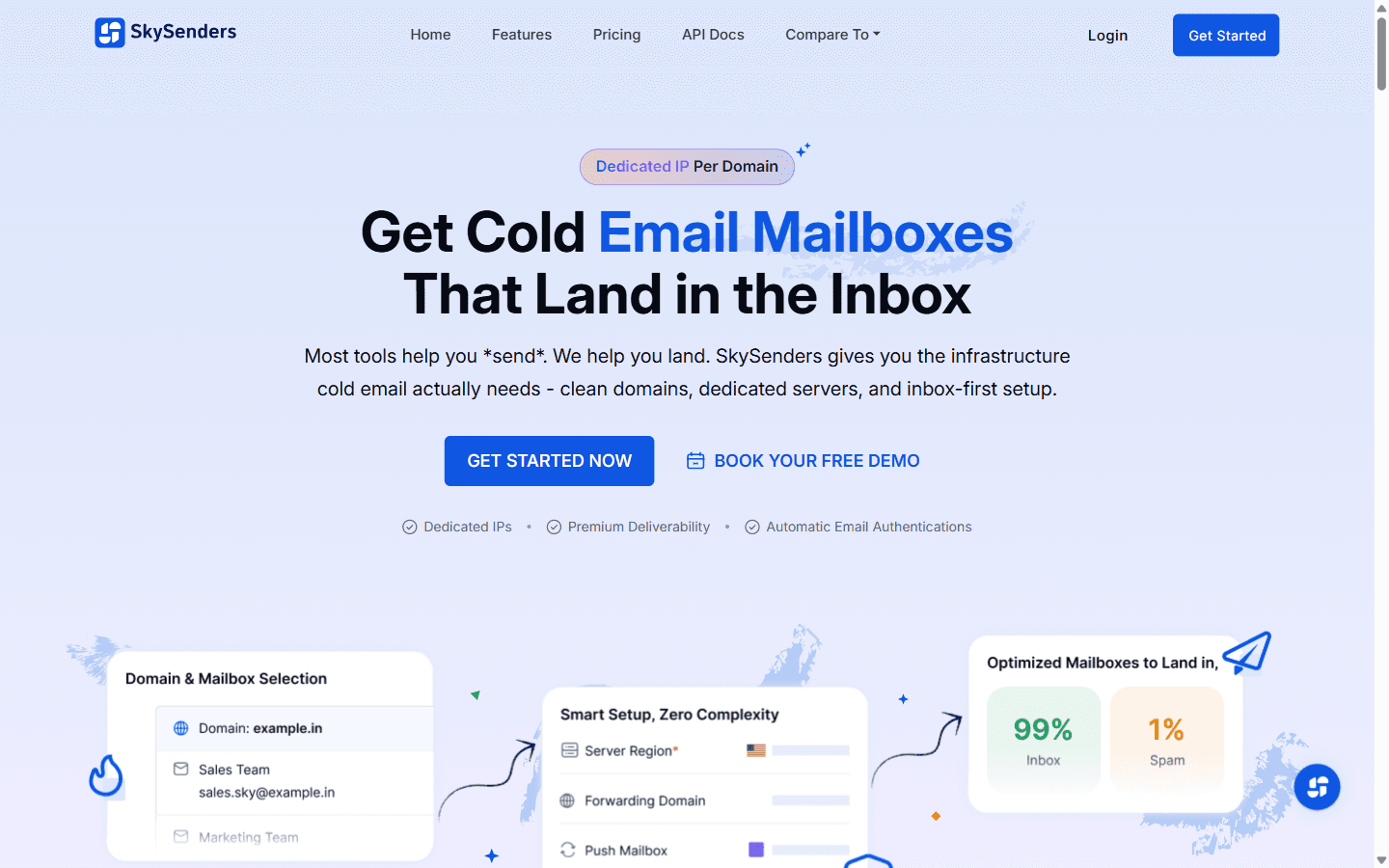
SkySenders (skysenders.ai) advertises itself as "an email platform with 99% inbox delivery" built specifically for cold outreach, on the premise that most email tools were not designed for email and therefore fail at it. Per SkySenders, it handles the full infrastructure stack so you can focus on campaigns: domain registration, DNS (DMARC, SPF, DKIM, custom tracking), dedicated servers, and mailbox creation.
The standout design choices SkySenders highlights:
It is a founder-led operation that discusses building the infra, DNS automation, deliverability logic, and mailbox orchestration in its own content. According to publicly available business records and third-party coverage, SkySenders operates as "SKY SENDERS PRIVATE LIMITED," with founder Ramesh Kumar Madhanlal referenced in third-party write-ups and the founder's own Reddit posts. The independent third-party review footprint is currently thin: at the time of writing we could not find a public review base on G2 or Trustpilot, and Reddit discussion is largely the founder's own posts and a small number of community responses.
SkySenders publishes tier pricing on its pricing page. The figures below were captured from skysenders.ai/pricing during original research; on our most recent re-fetch the pricing URL returned an access error (403), so the live numbers may have changed. Intro discounts in particular may shift, so always confirm the live price before purchasing:
| Tier | Price / month | Servers / domains / mailboxes |
|---|---|---|
| Starter | $59 (intro from $79) | 2 dedicated servers, 2 domains, 20 mailboxes (max 10/domain) |
| Growth | $139 (intro from $159) | 5 dedicated servers, 5 domains, 50 mailboxes (max 10/domain) |
| Essentials (most recommended) | $269 (intro from $299) | 10 dedicated servers, 10 domains, 100 mailboxes (max 10/domain) |
| Enterprise | Custom | Custom servers, more than 100 mailboxes, dedicated technical support |
All plans are advertised as including automated DKIM/SPF/DMARC, domain forwarding, custom tracking domain, the system status dashboard, analytics, and email integrations. Growth and Essentials add API access (60 req/min and 120 req/min respectively) and SkyBox (folder limits scale per tier).
Note: 10 mailboxes per domain (not high-density) is part of the isolation model, you scale with more servers rather than packing more mailboxes onto one domain.
This is a more complete, isolation-and-monitoring-oriented stack than most micro-niche providers, the dedicated-server-per-domain model and SkyBox are genuine differentiators.
SkySenders's publicly advertised deliverability story is built on the right foundations: dedicated servers per domain, dedicated IPs, clean DNS, and real-time monitoring. The isolation model is its strongest argument on paper, by giving each domain its own server, a flagged domain in theory cannot drag the rest of your fleet down, which is the kind of blast-radius control email needs at scale (we have not independently audited the underlying infrastructure).
The honest caveats:
The honest read: SkySenders presents as a sharp, well-designed private-infrastructure provider with isolation and monitoring baked in, and the SkyBox unified inbox is a nice operational touch. It suits agencies and operators who value control and isolation, just validate the deliverability claim yourself and get refund terms in writing before paying.
The summary below reflects publicly advertised strengths and limitations at the time of writing.
Pros
Cons
Good fit:
Bad fit:
| Provider | Model | Pricing | Best for |
|---|---|---|---|
| SkySenders | Dedicated server per domain | From $59/mo | Isolation + unified inbox, agency-friendly |
| wizeMails | Private infra + monitoring engine | From $179/mo | Always-on auto-remediating protection |
| Mission Inbox | IaaS, dedicated IPs + AI firewall | $199/mo | Owned infra for cold + transactional |
| InfraBoxes | Private/Google + burn alerts | ~$2.5-$3/mailbox | Cheap mailboxes with monitoring |
| InboxKit | Self-serve + monitoring | Bundled mailbox + InfraGuard | Inboxes plus real-time deliverability monitoring |
The honest positioning: SkySenders and InboxKit agree that isolation and monitoring should be built in, not bolted on. SkySenders leans into dedicated-server-per-domain isolation with a unified inbox; InboxKit pairs warmed, isolated mailboxes with InfraGuard (real-time blacklist alerts, DNS drift detection, and bounce-rate alerting). If you want maximum isolation and a founder-led partner, SkySenders is compelling; if you want comparable monitoring with a different inbox model, compare InboxKit. Disclosure: InboxKit is the publisher of this review.
Editorial rating: 7 / 10
SkySenders is a well-architected private email infrastructure provider that nails the fundamentals that matter at scale: dedicated-server-per-domain isolation, built-in real-time monitoring, automated DNS, and a unified SkyBox inbox so replies never slip through the cracks. Pricing is transparent and tiered ($59 Starter through $269 Essentials, plus custom Enterprise), and the deliverability guarantee is included on every paid plan. For agencies and operators who want control, isolation, and a hands-on founder-led partner, it's a strong option.
It is not higher than 7 because the operation is younger and smaller-scale than incumbents, the 99% inbox-delivery figure is self-reported, and the conservative 10-mailbox-per-domain density means per-mailbox cost sits above high-density Microsoft players. Validate placement with your own testing, and you have a capable, isolation-first provider.
If you want isolation and monitoring with a different inbox model and an established provider, see how InboxKit compares.
Public tier pricing on the pricing page: Starter $59/mo (2 servers, 20 mailboxes), Growth $139/mo (5 servers, 50 mailboxes), Essentials $269/mo (10 servers, 100 mailboxes), and a custom Enterprise tier. Intro pricing is displayed against higher original prices ($79/$159/$299).
It gives each domain its own dedicated server (strong isolation), plus a SkyBox unified inbox for replies and built-in real-time monitoring of delivery and system health.
It runs private infrastructure with dedicated servers and IPs rather than reselling Google/Microsoft seats, with automated DNS and custom tracking.
It's SkySenders's own claim. The isolation model makes strong placement plausible, but verify with your own inbox-placement testing before scaling.
Yes. It works with major email platforms and supports automatic push or CSV export of mailboxes, plus API access on Growth/Essentials/Enterprise tiers.
Free tools and pages that go with this guide.
From $2.50/mailbox/mo. No plans or slots. Automated DNS, warmup, and InfraGuard monitoring included.